Virtualization has transformed infrastructure flexibility, allowing IT teams to rapidly provision, snapshot, and scale environments. However, traditional hypervisors impose a strict "hypervisor tax." Whenever a virtual machine (VM) routes traffic through a software-based Linux bridge or Open vSwitch, or processes storage I/O through an emulated VirtIO controller, CPU overhead spikes and microsecond latencies are introduced.
For high-frequency trading applications, massively concurrent database clusters, or 100Gbps packet-processing firewalls, this virtual overhead is unacceptable. As highlighted by modern search trends surrounding vm performance, systems engineers are actively seeking ways to bypass the hypervisor entirely without losing the deployment benefits of virtual machines.
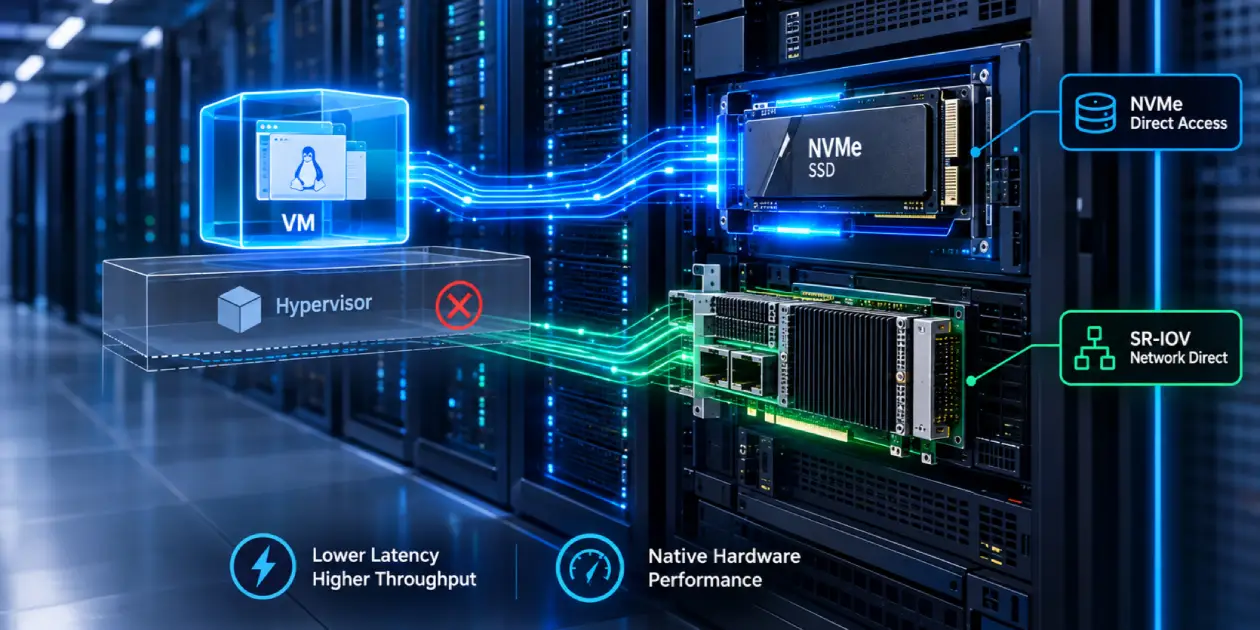
On dedicated bare-metal servers, advanced techniques like Single Root I/O Virtualization (SR-IOV) and PCIe Passthrough allow VMs to interact directly with the physical hardware, stripping away software abstraction to achieve near 100% native bare-metal performance.
The Power of PCIe Passthrough for NVMe Storage
PCIe passthrough relies on the Input-Output Memory Management Unit (IOMMU)—a CPU virtualization feature known commercially as Intel VT-d or AMD-Vi. IOMMU securely partitions physical devices into isolated hardware groups, allowing the hypervisor to map a physical PCIe device directly into a VM's isolated memory space.
For storage-heavy workloads, bypassing emulated SCSI or virtual block devices is a game-changer. Passing a physical enterprise NVMe SSD directly to a VM means the guest operating system loads the native NVMe driver, interacting with the hardware as if the hypervisor didn't exist.
To configure this in modern environments like Proxmox VE or KVM, you must enable IOMMU in the server BIOS, append intel_iommu=on or amd_iommu=on to your GRUB kernel boot parameters, and assign the specific PCI device ID directly to the target VM utilizing the vfio-pci driver.
SR-IOV: Slicing the Network Interface at the Silicon Level
While PCIe passthrough is ideal for dedicated storage drives, passing through an entire 25GbE or 100GbE Network Interface Card (NIC) to a single VM is highly inefficient. This is where SR-IOV (Single Root I/O Virtualization) becomes invaluable.
SR-IOV allows a single compatible PCIe network device to present itself as multiple independent physical devices at the hardware level. The physical hardware is represented as a Physical Function (PF), which remains managed by the host OS. The PF can then be sliced into dozens of isolated Virtual Functions (VFs).
Near-Native Throughput: Each VM is assigned its own dedicated VF. The VM essentially receives a direct hardware pipeline to the top-of-rack network switch, bypassing the hypervisor's virtual networking stack entirely.
Reduced CPU Load: Because the physical NIC's ASIC handles packet switching, MAC assignment, and VLAN tagging natively in hardware, the host CPU is entirely relieved of the burden of processing software bridge routing.
High-Density Multi-Tenancy: A single dual-port 10Gbps or 100Gbps NIC can support multiple VMs, all operating at line rate without cross-VM software interference or packet queuing delays.
The iDatam Bare-Metal Advantage
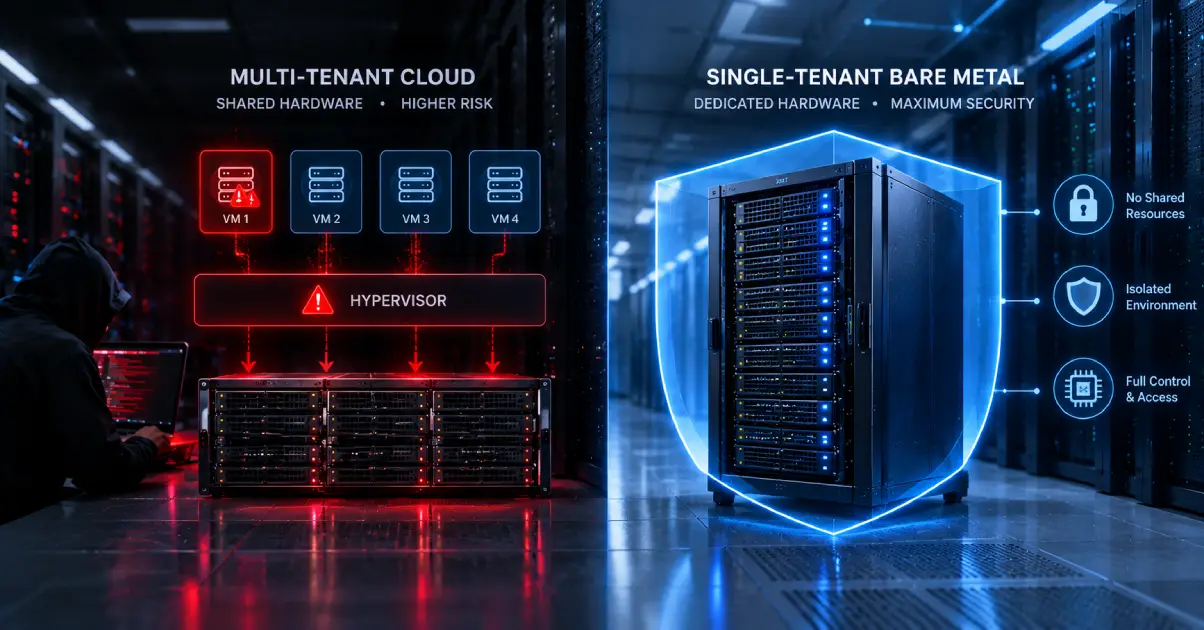
Extracting this elite level of virtual performance is physically impossible on shared hyperscaler instances (like AWS, Azure, or GCP). In public cloud environments, the underlying IOMMU architecture, BIOS settings, and PCIe lanes are locked away behind the provider's opaque abstraction layers. You are forced to consume network and storage resources exactly as the cloud provider dictates.
iDatam provisions raw, uncompromised bare-metal servers. With absolute root access to the physical machine and premium hardware featuring Enterprise NVMe drives and SR-IOV-capable Mellanox or Intel NICs, you hold the keys to the kingdom. You have the total freedom to enter the BIOS, activate IOMMU, compile custom VFIO drivers, and architect hyper-optimized virtual machines that operate at the absolute limits of silicon physics.
Frequently Asked Questions
iDatam Recommended Resources

Hardware
Why Are Intel, AMD, and Ampere Dominating the CPU Market?
When we choose a CPU, we had a lot to consider. However, the landscape of CPUs is mainly dominated by a few key companies depending on the market segment. No matter what kind of CPUs you're looking for, here's a breakdown of how things evolved and where they stand today.


Hardware
What is ARM?
ARM (Advanced RISC Machines) is a widely used family of RISC architectures developed by Arm Ltd., known for its energy efficiency and scalability. Since its founding in 1990, over 180 billion ARM-based chips have been shipped, making it the leading processor family globally.

Hardware
A Complete Guide to RAID Configurations: Balancing Performance and Data Protection
This guide digs into the world of RAID configurations, examining their advantages, disadvantages, and ideal use cases, as businesses and individuals increasingly seek ways to optimize their storage solutions in a data-driven world.
Discover iDatam Dedicated Server Locations
iDatam servers are available around the world, providing diverse options for hosting websites. Each region offers unique advantages, making it easier to choose a location that best suits your specific hosting needs.