The New Center of Gravity for Southern Europe
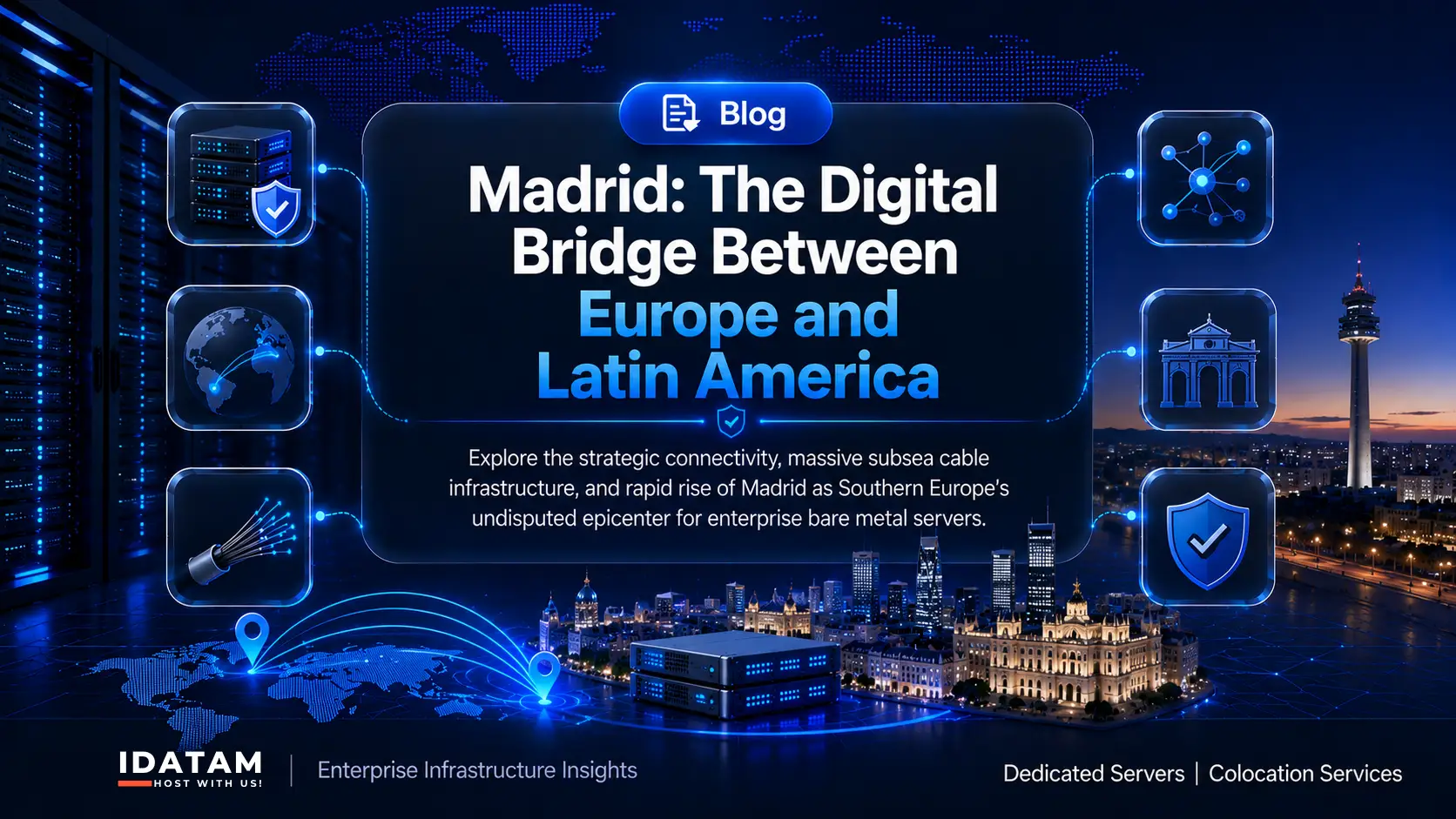
When architects of global IT networks look at Europe, their focus traditionally defaults to the "FLAP" markets: Frankfurt, London, Amsterdam, and Paris. However, over the past decade, a quiet but massive infrastructural revolution has taken place on the Iberian Peninsula. Today, Madrid has transformed into the economic powerhouse and primary digital gateway of Southern Europe.
The rise of Madrid is driven by its incredibly strategic geography. It is no longer just a hub for Spanish enterprise; it acts as the primary data intersection between Europe, North Africa, and, most importantly, Latin America. For international corporations, hyperscalers, and SaaS providers, deploying a Madrid dedicated server has become a vital maneuver to capture the rapidly growing Spanish-speaking digital markets without sacrificing connectivity to northern Europe.
In this technical overview, we will explore the network topologies that make Madrid so unique. We will delve into the power of local peering exchanges like DE-CIX and ESpanix, the impact of new transatlantic submarine cables, and why Spain's push for 100% green energy is redefining enterprise data center standards.
1. The Peering Powerhouse: DE-CIX Madrid and ESpanix
A data center is only as powerful as the networks it connects to. Madrid's ascension as a Tier-1 tech hub is largely due to the immense density of its Internet Exchange Points (IXPs).
ESpanix: The Local Champion
ESpanix is the Spanish Internet Exchange and the largest peering point in the country. For businesses targeting the domestic market, peering at ESpanix allows your bare metal servers to exchange traffic directly with major Spanish ISPs like Movistar, Vodafone, Orange, and MasMovil. This eliminates international transit routing, pushing latency for domestic e-commerce or streaming traffic down to an incredibly fast 3 to 8 milliseconds.
DE-CIX Madrid: The Global Nexus
On the international front, DE-CIX (the operator behind Frankfurt's massive exchange) established DE-CIX Madrid. It serves as a crucial hub at the heart of the largest interconnection ecosystem in Southern Europe. DE-CIX Madrid provides direct connections to sister exchanges in Lisbon, Barcelona, Marseille, and Frankfurt. This means that traffic originating from a server in Madrid can flow seamlessly into North Africa or straight up to Germany without hitting a single congested public transit bottleneck.
2. Submarine Cables: The Latin American Connection
Perhaps the most compelling reason to rent a dedicated server in Madrid is its role as an aggregation point for submarine cables. While Madrid is landlocked, it serves as the terrestrial heart for fiber landing on the Iberian coast.
Historically, traffic moving from Latin America to Europe had to route up through North America (Miami/New York) before crossing the Atlantic to London. This added massive latency. Today, cables like EllaLink connect Brazil directly to Portugal and Spain. Similarly, the MAREA cable connects Virginia (USA) directly to Bilbao, Spain.
Traffic from these coastal landing stations aggregates directly into Madrid's data centers. This makes Madrid the absolute lowest-latency European entry point for Latin American traffic. For a global SaaS platform serving both the EU and LatAm, Madrid is the perfect deployment endpoint.
Strategic Latency Benchmarks from Madrid
| Destination | Approx. Round-Trip Time (ms) | Strategic Advantage |
|---|---|---|
| Barcelona (CATNIX) | 8 - 10 ms | Instantaneous domestic synchronization. |
| Lisbon, Portugal | 10 - 12 ms | Seamless integration across the Iberian Peninsula. |
| Paris (France-IX) | 22 - 25 ms | Highly efficient routing to Northern European FLAP markets. |
| Sao Paulo, Brazil | 180 - 200 ms | The fastest, most direct route from Europe to LatAm, bypassing North America. |
Note: Real-world RTT varies with carrier path, traffic, and TCP retransmission.
3. Setting the Standard for Green Energy IT
As global energy costs fluctuate and corporate Environmental, Social, and Governance (ESG) requirements tighten, the sustainability of data center infrastructure is under heavy scrutiny. Spain, and Madrid by extension, has emerged as a leader in this space.
Spain possesses a robust capacity for solar and wind power generation. Many top-tier data center campuses in Madrid are now directly connected to photovoltaic (PV) solar farms or operate on matched 100% renewable energy grids. This commitment to sustainable operations means that businesses deploying high-density bare metal servers in Madrid can actively reduce their carbon footprint. By utilizing naturally efficient liquid-ready cooling architectures and targeting aggressive PUE (Power Usage Effectiveness) ratings as low as 1.2, Madrid facilities offer enterprise power without the environmental guilt.
4. High-Performance Enterprise Security
When deploying mission-critical applications, shared cloud environments often introduce unacceptable risks regarding data privacy and "noisy neighbor" resource contention. Renting a physical, dedicated server in Madrid eliminates these vulnerabilities entirely.
Total Hardware Isolation: A bare metal server guarantees that 100% of the CPU, RAM, and NVMe storage is dedicated solely to your workloads. This is crucial for resource-heavy databases or enterprise ERP systems.
European Data Sovereignty: By keeping data physically located within Spain, organizations ensure full compliance with the European Union's GDPR framework, as well as strict Spanish public-sector security standards (ENS).
Military-Grade Facility Defense: Premium Madrid facilities boast rigorous cyber and physical security protocols, including biometric authentication, 24/7 security staffing, and continuously tested penetration defenses.
Conclusion: The Undisputed Southern Hub
Madrid is no longer an emerging secondary market; it is a vital necessity for any global network topology. By acting as a geographic bridge between Europe, Africa, and Latin America, it offers connectivity advantages that simply cannot be replicated by data centers further north.
Coupled with the unparalleled peering capabilities of DE-CIX and ESpanix, and a deep commitment to 100% green energy operations, Madrid stands out as the smartest deployment zone for companies seeking high performance, strict EU compliance, and latency-free access to Spanish-speaking markets.
Ready to secure your footprint in Southern Europe? Deploy a high-performance bare metal dedicated server in Madrid today and unlock true global scale.
iDatam Recommended Resources

Hardware
Why Are Intel, AMD, and Ampere Dominating the CPU Market?
When we choose a CPU, we had a lot to consider. However, the landscape of CPUs is mainly dominated by a few key companies depending on the market segment. No matter what kind of CPUs you're looking for, here's a breakdown of how things evolved and where they stand today.


Hardware
What is ARM?
ARM (Advanced RISC Machines) is a widely used family of RISC architectures developed by Arm Ltd., known for its energy efficiency and scalability. Since its founding in 1990, over 180 billion ARM-based chips have been shipped, making it the leading processor family globally.

Hardware
A Complete Guide to RAID Configurations: Balancing Performance and Data Protection
This guide digs into the world of RAID configurations, examining their advantages, disadvantages, and ideal use cases, as businesses and individuals increasingly seek ways to optimize their storage solutions in a data-driven world.
Discover iDatam Dedicated Server Locations
iDatam servers are available around the world, providing diverse options for hosting websites. Each region offers unique advantages, making it easier to choose a location that best suits your specific hosting needs.