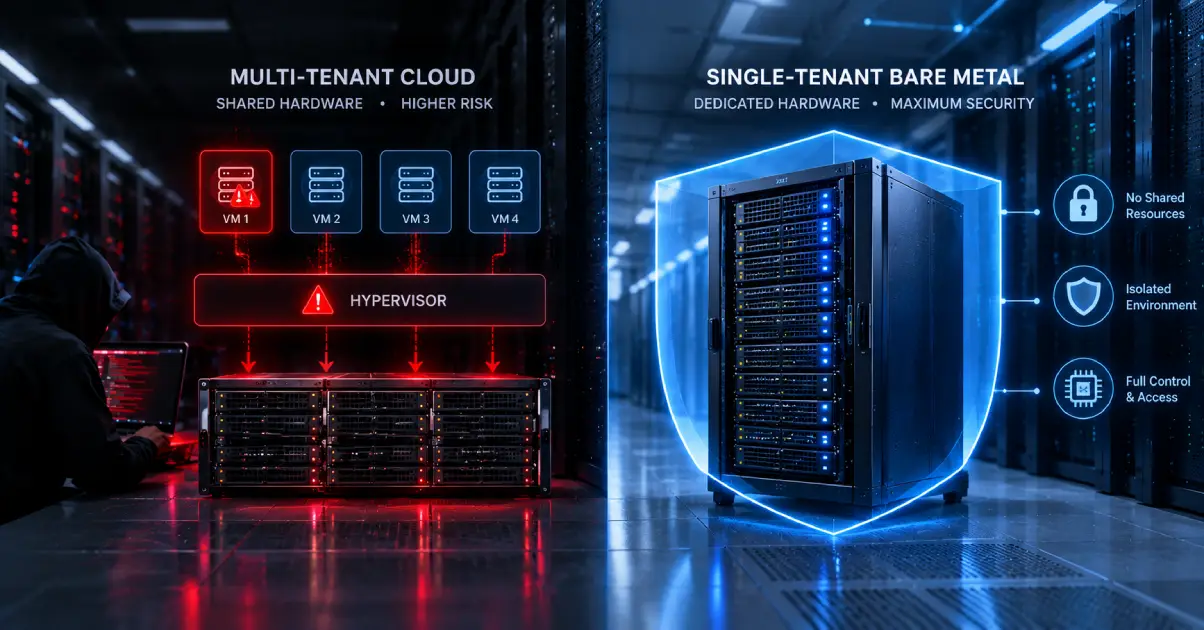
For over a decade, public cloud hyperscalers have operated on a fundamental promise: logical isolation is as secure as physical isolation. By placing a software abstraction layer known as a hypervisor between physical hardware and guest virtual machines (VMs), cloud providers assured enterprises that multiple competing companies, web applications, and databases could safely coexist on the exact same physical server.
In 2026, that assumption has completely unraveled.
Hardware-level CPU vulnerabilities have repeatedly demonstrated that software rules cannot contain physical silicon flaws. When multiple tenants share a single physical CPU, security boundaries are governed not by the hypervisor’s software code, but by the physical architecture of the processor chip itself.
If an attacker rents a budget virtual machine on the same physical host as your enterprise database, a hardware-level flaw allows them to bypass the hypervisor entirely. Understanding how CPU protection rings function—and why shared hardware fails under stress—is essential for any technology leader charged with protecting high-value enterprise data.
Understanding CPU Protection Architecture: How Rings Work
To understand why multi-tenant cloud environments are vulnerable to cross-tenant attacks, you must first look at how modern Intel processors manage permission levels.
Intel microprocessors utilize a hardware-enforced privilege model known as Protection Rings. These rings form concentric circles of security embedded directly into the physical CPU architecture, numbered from Ring 3 down to Ring 0:
Ring 3 (User Mode): This is the lowest privilege level. All standard user-space applications, web servers, and customer code execute in Ring 3. Applications running here have no direct access to physical memory or hardware resources; every request must be brokered by the operating system kernel.
Rings 1 and 2: Historically reserved for device drivers and system services, these rings are rarely used in modern 64-bit operating systems.
Ring 0 (Supervisor / Kernel Mode): This is the highest, most privileged execution level on the CPU. The operating system kernel and the underlying cloud hypervisor operate in Ring 0. Code executing in Ring 0 has completely unrestricted, direct access to all physical hardware, including system memory (RAM), storage controllers, and CPU execution pipelines.
How Hypervisors Slice a Server in the Cloud
In a public cloud environment (AWS, Azure, Google Cloud), a software hypervisor—such as KVM, VMware ESXi, or Xen—runs directly at Ring 0. The hypervisor's job is to slice a single, physical dedicated server into dozens of smaller virtual machines by virtualizing three core components:
Virtual CPUs (vCPUs): The hypervisor schedules time-slices on physical CPU cores and assigns them to guest VMs.
Memory Mapping: The hypervisor creates an abstraction layer that maps each VM’s virtual memory space to specific physical addresses in system RAM.
I/O Isolation: All network traffic and disk storage calls pass through virtualized software interfaces controlled by the hypervisor.
Under standard conditions, this software traffic cop keeps VM #1 from reading memory allocated to VM #2. However, this entire security model relies on a single critical assumption: that the physical CPU silicon executes instructions with 100% mathematical perfection. When a flaw exists inside the processor's physical logic or microcode, that assumption collapses.
In August 2026, the security research community and Intel officially disclosed CVE-2025-35973 (documented under Intel Security Advisory INTEL-SA-01428), a critical hardware vulnerability affecting modern Intel Xeon and Core processor architectures. It represents a severe breakdown in processor-level privilege boundaries stemming from an improper state management flaw within Intel's Ring 0 execution logic.
The Exploit Mechanism: Breaking the Hypervisor
In a shared cloud environment, this means a malicious actor sitting on the same physical chip can silently read your company's SSL private keys, unencrypted database records, proprietary AI models, and API tokens directly out of memory—without ever breaking into your virtual machine's operating system.
Why "Patching" Shared Silicon Destroys Cloud Performance
When hardware-level vulnerabilities like CVE-2025-35973 are discovered, cloud providers face a terrible trade-off. Because the bug resides in physical silicon, it cannot be fixed by updating an application or operating system. It requires an Intel Microcode Update—a low-level firmware patch pushed to the processor chip itself.
To fix a Ring 0 hardware vulnerability, the microcode patch usually works by disabling or restricting the optimized physical hardware features that caused the flaw in the first place.
For public cloud tenants, these microcode updates trigger two major problems:
Severe Performance Degradation: Disabling speculative execution paths or adding mandatory safety flushes to the CPU pipeline drastically slows down processing throughput. Depending on the workload, microcode patches for hardware vulnerabilities can cause CPU performance penalties ranging from 10% to over 35%.
Unpredictable Latency Spikes: In a public cloud environment, the provider applies microcode updates across their data centers on their own timeline. Cloud tenants suddenly experience unexpected CPU throttling, higher database query times, and erratic application performance, with zero control over the underlying hardware changes.
Single-Tenant Bare Metal: Security Through Physical Isolation
The fundamental flaw of the public cloud is not the hypervisor software itself—it is multi-tenancy. As long as your data executes on a physical CPU chip shared with untrusted third parties, your security posture is entirely dependent on zero hardware bugs existing in that chip.
This is why high-compliance industries, financial institutions, and tech-forward enterprises are migrating sensitive workloads to single-tenant dedicated bare-metal servers.
Why Bare Metal Eliminates the Threat Vector
When you deploy on an iDatam dedicated server, you eliminate the threat of CVE-2025-35973 and future zero-day hardware exploits by removing the physical prerequisite for the attack:
Zero Shared Silicon: You are the sole tenant of the physical Intel Xeon processor, system motherboard, memory channels, and NVMe storage. There are no external virtual machines operating on your hardware.
Impossible Cross-Tenant Escapes: Even if a zero-day vulnerability exists in the processor's Ring 0 execution logic, an external attacker cannot exploit it against you because they have no physical or virtual presence on your host machine. The attack surface is completely eliminated at the hardware layer.
Control Over Performance and Patching: On dedicated bare metal, you decide if, when, and how microcode updates are applied. You maintain complete sovereignty over your hardware configuration, ensuring that your enterprise applications run at 100% raw, unthrottled CPU performance.
Defending Against Side-Channel Exploits: Hardware side-channel attacks rely on measuring cache timing or power draw across shared CPU cores. On dedicated bare metal, your workloads own the entire L1, L2, and L3 cache structure, rendering side-channel data leakage mathematically impossible.
The Verdict: Moving Beyond the Multi-Tenant Illusion
The disclosure of CVE-2025-35973 is a stark reminder that software abstraction cannot override physical reality. As processors grow increasingly complex, hardware-level vulnerabilities in Ring 0 execution will continue to emerge.
Relying on a software hypervisor to isolate your most critical corporate assets on shared public cloud hardware is a massive, unnecessary business risk. By transitioning high-value databases, financial systems, and proprietary applications to single-tenant, physically isolated bare-metal infrastructure from iDatam, enterprises can replace the illusion of software security with the absolute guarantee of physical hardware boundaries.
Frequently Asked Questions
iDatam Recommended Resources

Hardware
Why Are Intel, AMD, and Ampere Dominating the CPU Market?
When we choose a CPU, we had a lot to consider. However, the landscape of CPUs is mainly dominated by a few key companies depending on the market segment. No matter what kind of CPUs you're looking for, here's a breakdown of how things evolved and where they stand today.


Hardware
What is ARM?
ARM (Advanced RISC Machines) is a widely used family of RISC architectures developed by Arm Ltd., known for its energy efficiency and scalability. Since its founding in 1990, over 180 billion ARM-based chips have been shipped, making it the leading processor family globally.

Hardware
A Complete Guide to RAID Configurations: Balancing Performance and Data Protection
This guide digs into the world of RAID configurations, examining their advantages, disadvantages, and ideal use cases, as businesses and individuals increasingly seek ways to optimize their storage solutions in a data-driven world.
Discover iDatam Dedicated Server Locations
iDatam servers are available around the world, providing diverse options for hosting websites. Each region offers unique advantages, making it easier to choose a location that best suits your specific hosting needs.