For over two decades, the blueprint for enterprise IT infrastructure deployment across the United States followed a highly predictable model: establish a primary footprint in a single massive data center corridor, scale it vertically until resource constraints appeared, and rely on standard software-based content delivery networks (CDNs) to patch over the latency gaps for users on the opposite coast. However, as we move through 2026, that legacy approach has reached its technical and physical limits.
The structural evolution of the digital economy has completely reshaped the operational demands placed on corporate data grids. The rapid transition of artificial intelligence workloads from initial large-scale models to real-time, distributed edge execution has fundamentally altered how data centers function. Simultaneously, massive big data compilation pipelines, complex e-commerce delivery networks, and real-time multiplayer gaming architectures require unprecedented processing speeds.
When a modern digital platform handles millions of concurrent global requests, relying on a monolithic, single-region data center layout introduces substantial risks. Geographical distance introduces unavoidable network delays, and a single localized infrastructure outage can completely compromise business continuity across the continent.
To address these challenges, forward-thinking enterprise technology leaders are completely redesigning their infrastructure. Building a resilient, high-performance network across the vast expanse of the United States requires moving beyond isolated hosting environments. By establishing distributed computing setups across key national network corridors, organizations can achieve true multi-region availability, minimize point-to-point data transit delays, and tap into the raw performance of unshared physical assets. Deploying scalable, single-tenant dedicated servers in the USA allows modern enterprises to eliminate network bottlenecks and build an unshakeable digital foundation tailored for 2026 and beyond.
The Fallacy of the Monolithic Deployments
The primary challenge of hosting digital systems across the United States is the immense geographical scale of the North American continent. The physical distance between major economic hubs on the East and West Coasts spans roughly 3,000 miles. When data packets transit over long-haul terrestrial fiber networks, they are governed by the speed of light through glass, along with processing delays introduced by routing hardware and amplifiers along the path.
When an organization consolidates its entire compute architecture into a single location—for example, within the traditional Northern Virginia data corridor—any user interaction or automated API request originating from California, Washington, or Oregon faces an inescapable physical latency penalty. Under standard operating conditions, a data packet traveling round-trip from Los Angeles to Ashburn takes roughly 65 to 80 milliseconds.
While a 75-millisecond delay might seem minor to a casual observer, its cumulative effect on complex enterprise applications is significant. Modern software architectures routinely perform dozens of synchronous database queries, external API calls, and asset requests to generate a single user interface view. When every individual transaction must cross the continent and back, user experiences quickly degrade, resulting in system lag and dropped connections.
Furthermore, a single-region deployment lacks structural protection against unpredictable regional network disruptions, power grid failures, or routing anomalies. Relying on a monolithic layout means exposing your entire enterprise availability to localized risks. True resilience requires distributing workloads across independent geographical zones, placing raw computing power closer to the edge where your users actually interact with your systems.
Ashburn and New York: The Financial and Transatlantic Corridors
To construct a high-speed, distributed infrastructure blueprint, an organization must understand the specific connectivity advantages of key regional network hubs. On the eastern seaboard of the United States, two markets stand as critical anchors for global data transit and high-speed financial processing: Ashburn, Virginia, and New York City.
Ashburn: The Global Core of Capital Connectivity
The Ashburn data center hub represents the single densest concentration of internet connectivity and fiber optic routing on earth. An estimated 70% of the world's daily digital traffic passes through the extensive fiber pathways of Loudoun County.
Ashburn functions as the primary routing capital for enterprise cloud platforms, international transit lines, and domestic backbones. Deploying infrastructure here places your core computing nodes directly adjacent to the primary peering networks of the global internet, offering exceptionally low hops to partner grids, enterprise networks, and corporate API systems.
New York City: The Sovereign Bridge to Europe
While Ashburn serves as the primary data highway for corporate traffic, New York City functions as the vital economic and telecommunications bridge linking North America to the European continent. For financial trading firms, algorithmic clearinghouses, and global software providers, utilizing premium New York bare metal hardware is an absolute operational necessity.
New York City acts as the primary landing zone for next-generation trans-Atlantic submarine cables, such as the Amitie and Dunant cable lines. These subsea pathways establish direct, high-capacity conduits to major European network centers like London and Frankfurt.
By operating physical systems in New York, organizations can achieve ultra-low trans-Atlantic round-trip times, allowing multi-national platforms to sync critical datasets, process international financial transactions, and deliver lightning-fast responses to users on both sides of the ocean simultaneously.
Los Angeles: The Strategic Transpacific Gateway
On the western coast of the United States, the infrastructure focus shifts entirely from trans-Atlantic connectivity to managing the immense digital demands of the Pan-Asian and domestic West Coast economies. Within this region, Los Angeles stands as the premier gateway for transpacific network traffic.
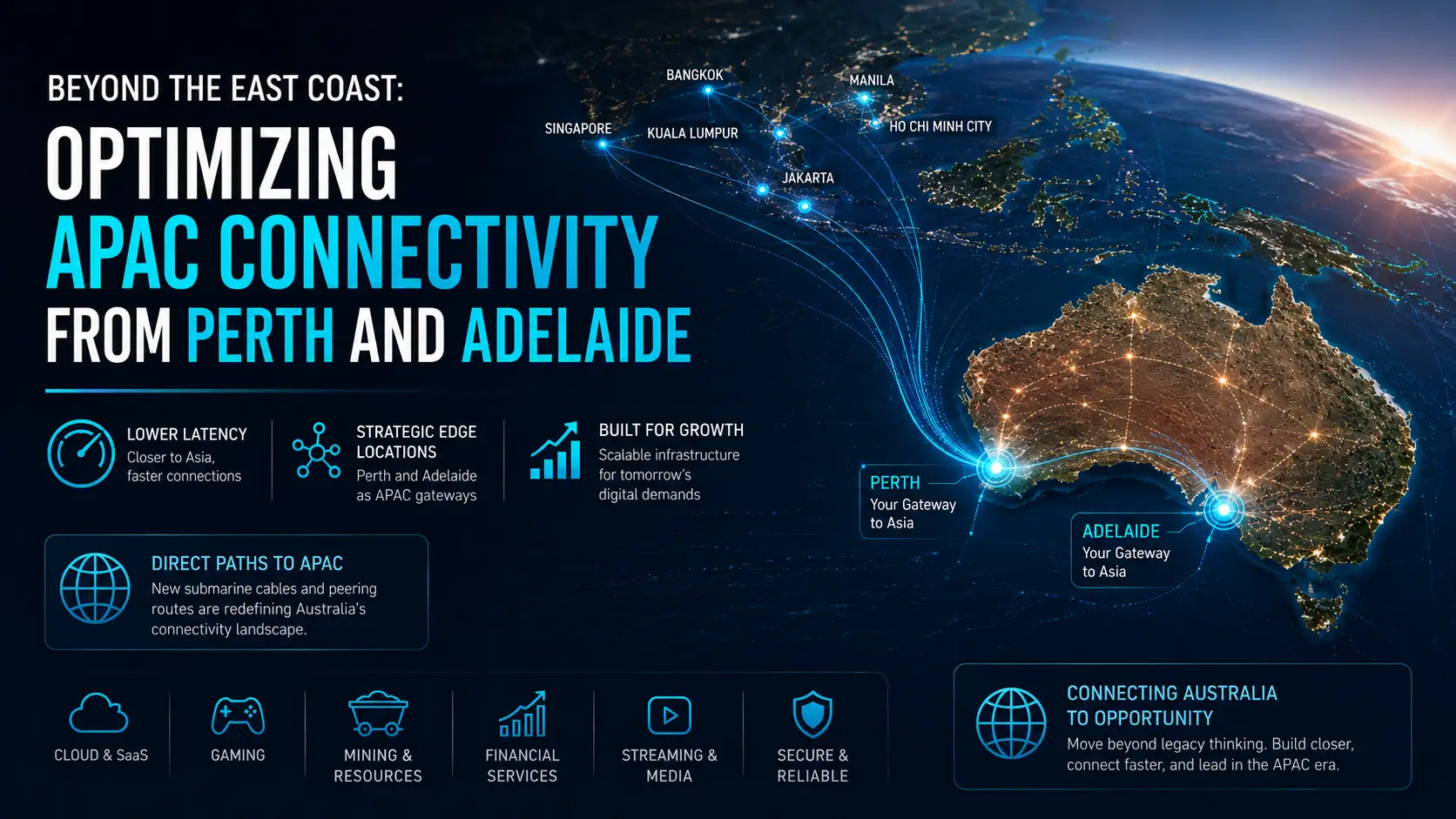
Historically, internet traffic moving between Asia and the United States encountered massive latency penalties as data packages transitioned through multiple coastal landing points before heading inland. In 2026, the landscape has evolved significantly through extensive investments in high-capacity submarine cable networks. Systems like the Echo and Bifrost cables route directly into Southern California, linking the US West Coast straight to key Asian digital capitals including Singapore, Jakarta, Tokyo, and Hong Kong.
By leveraging Los Angeles infrastructure, enterprises targeting international expansion can achieve remarkable performance gains. Round-trip times from California to major Asian network hubs are drastically reduced compared to routing that traffic from the East Coast.
For real-time collaboration platforms, high-traffic streaming services, and international corporate networks, deploying physical compute assets in Los Angeles ensures that users across the Pacific rim experience consistent, responsive connections. Furthermore, an LA presence provides essential geographical separation, creating an independent routing loop that protects your systems against major trans-Atlantic cable disruptions or East Coast infrastructure failures.
Dallas: The Central Pivot for North American Routing
While the coastal corridors of New York, Ashburn, and Los Angeles handle the influx of international data traffic, managing internal domestic routing efficiently requires a central anchor point. Positioning infrastructure only on the coasts leaves users in the American Midwest, South, and Central regions at a disadvantage, forcing data to travel long distances across the continent. This is where Dallas, Texas, functions as the ultimate central hub for North American data distribution.
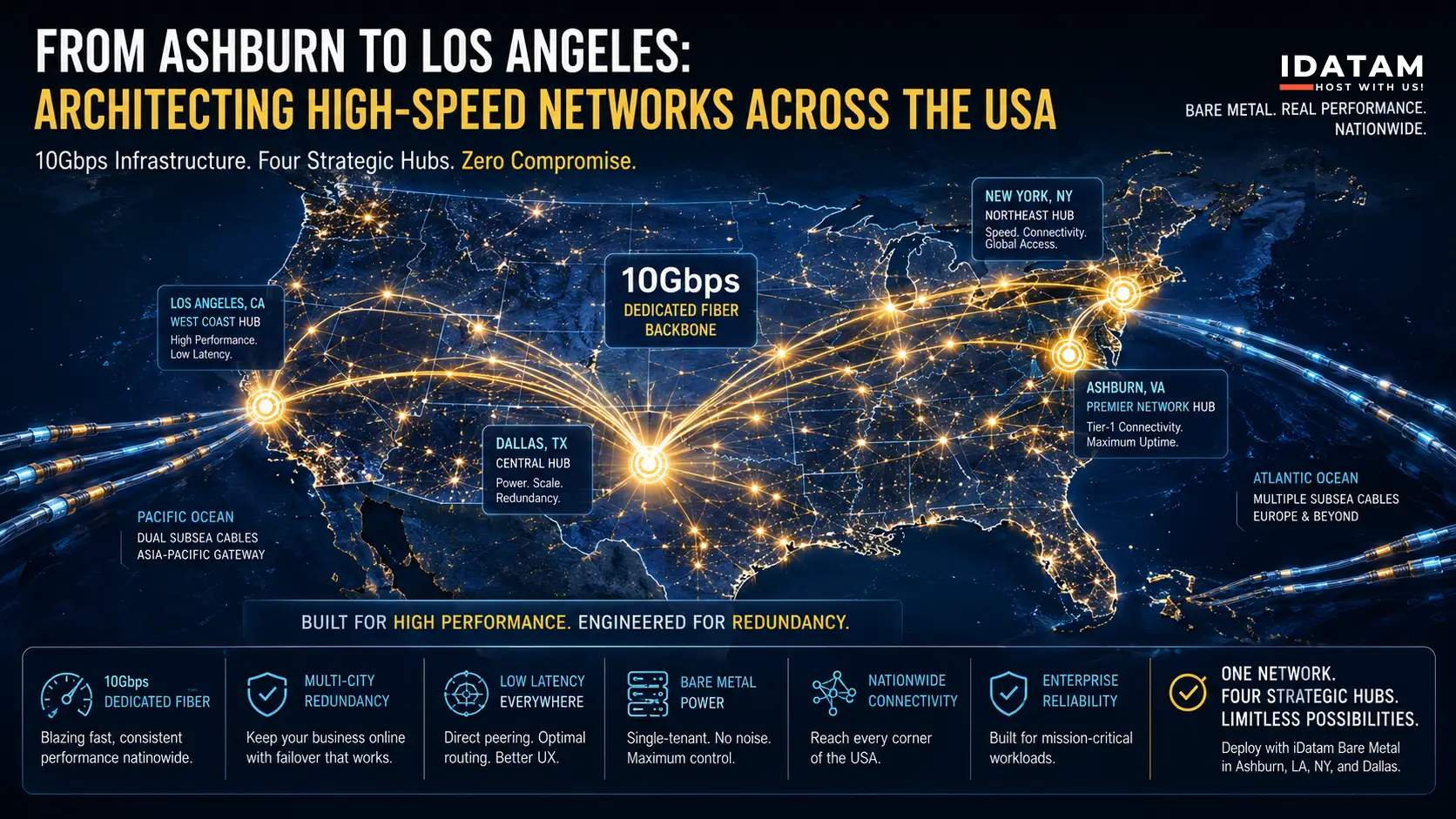
Dallas is strategically positioned at the intersection of major transcontinental fiber optic corridors, acting as a natural geographic pivot for traffic moving north-to-south and east-to-west. Data packets routed through Dallas can reach any major metropolitan area within the contiguous United States in under 30 milliseconds, creating a perfectly balanced performance baseline for nationwide service delivery.
| Regional Hub | Primary Strategic Role | Key Connectivity Advantages | Target Workloads |
|---|---|---|---|
| Ashburn | Global Peering Capital | Access to 70% of global daily internet traffic | Enterprise API grids, Core backends |
| New York | Transatlantic Bridge | Direct links via next-gen subsea cables to Europe | Financial tech, High-frequency trading |
| Los Angeles | Transpacific Gateway | Direct routes via Echo/Bifrost subsea lines to Asia | Pan-Asian SaaS, Media streaming |
| Dallas | Central Routing Hub | Centralized geography, low-latency nationwide paths | Nationwide e-commerce, Disaster recovery |
Beyond its exceptional network routing, the region offers unique operational benefits. Texas maintains an independent electrical grid (ERCOT) with substantial domestic power generation capabilities, providing a layer of utility infrastructure isolation from the rest of the country.
For growing startups, SaaS companies, and enterprise systems building multi-region environments, deploying affordable Dallas hardware provides an ideal, cost-effective center for data synchronization, live application replication, and reliable disaster recovery storage outside of primary coastal threat zones.
The Power of 10Gbps Single-Tenant Infrastructure
As the scale of corporate data processing escalates, the limitations of standard virtualized cloud infrastructure have become increasingly apparent. In a conventional shared cloud environment, your business applications operate inside an abstracted virtualization layer, sharing physical processor cores, system memory buses, and network interfaces with thousands of unmonitored external tenants.
For modern, resource-intensive operations—such as executing real-time artificial intelligence inference models, running large-scale data analytics pipelines, or managing intensive database transactions—this multi-tenant framework creates significant operational hurdles. Your applications remain constantly vulnerable to the "noisy neighbor" effect, where unexpected traffic spikes from an adjacent tenant on the same physical host can cause sudden, unpredictable performance drops and lag.
Stepping away from virtualized cloud systems and adopting dedicated physical infrastructure eliminates these performance issues completely. Utilizing high-performance 10gbps infrastructure in the USA ensures that every element of your server stack—from the enterprise-grade processors and Error-Correcting Code (ECC) memory to the dedicated high-capacity network port—is exclusively allocated to your specific business operations.
A dedicated 10Gbps network pipe provides the immense throughput required to transfer massive datasets, handle sudden, multi-million user traffic surges, and maintain continuous, low-latency data replication across your regional infrastructure hubs without facing bandwidth limitations or artificial cost penalties.
Protecting Network Baselines: Hardware-Accelerated DDoS Mitigation
In an era where business continuity is entirely dependent on continuous online availability, the scale and complexity of cyber threats continue to escalate. In 2026, large-scale distributed denial-of-service (DDoS) campaigns have become standard tools for digital extortion and competitive disruption, frequently targeting high-traffic web properties, corporate API gateways, and enterprise application backends.
A standard software-based firewall running inside an application stack cannot defend against a modern volumetric attack. If an automated botnet targets your public IP infrastructure with hundreds of gigabits of synthetic traffic, your network interfaces will become completely saturated long before your software layer can inspect or drop the incoming packets.
Effective defense requires an enterprise-grade, hardware-accelerated mitigation architecture built directly into the core carrier routing edge. This system actively inspects and filters network traffic at full line-rate capacity before it can ever approach your server's physical ports:
(Pure, Authorized Data)
By identifying and dropping malicious reflection and amplification attacks at the network edge, advanced mitigation systems ensure that your dedicated hardware only encounters legitimate, authorized traffic requests. This automated, multi-layered security framework protects your systems from artificial resource exhaustion, safeguards application performance, and guarantees that your core databases and enterprise portals remain stable and accessible to your global users during major online disruptions.
The iDatam Nationwide Infrastructure Blueprint
Deploying a high-performance enterprise footprint that successfully balances low latency with complete multi-region redundancy demands an experienced and reliable infrastructure partner. iDatam has specifically designed its footprint across the United States to provide organizations with an unmatched combination of raw computational performance, extensive network reach, and advanced technical support.
Complete Bi-Coastal and Central Presence
iDatam’s physical network spans the country's most critical connectivity corridors. Whether your operations require premium, ultra-connected deployments inside the core Ashburn data center hub, high-frequency financial platforms using New York bare metal, transpacific routing from Los Angeles, or central domestic balancing with affordable Dallas hardware, iDatam offers a uniform, enterprise-grade hosting environment across the entire nation.
Enterprise Bare-Metal Component Standards
iDatam refuses to compromise on the internal architecture of its systems. Every server configuration is assembled using top-tier, modern components engineered for continuous enterprise performance:
Next-generation AMD EPYC and Intel Xeon Scalable processors featuring massive core counts to manage dense parallel computing tasks.
Scalable, high-speed DDR5 ECC (Error-Correcting Code) memory setups that actively detect and repair memory errors before they can cause system instability.
Blazing-fast NVMe solid-state storage arrays configured in redundant hardware RAID setups, providing exceptional input/output speeds alongside data mirroring security.
Comprehensive High-Capacity Networking
To complement high-performance computing, iDatam’s network routing utilizes premium global and domestic carriers, ensuring clean paths, minimal point-to-point hops, and low latency across the continent. Bandwidth allocations can be precisely tailored to match your specific corporate operational requirements, offering multi-gigabit configurations and dedicated high-capacity uplinks to prevent data transfers from becoming an application bottleneck.
Securing the Digital Future of Your Business
The modern digital economy rewards organizations that recognize that infrastructure performance, network speed, and multi-city redundancy are deeply connected. Attempting to manage high-traffic enterprise platforms, sensitive corporate databases, or real-time AI processing applications within a single, isolated cloud region creates unnecessary latency penalties and serious operational vulnerabilities.
Choosing localized, single-tenant configurations across strategic national network exchanges provides your business with a resilient, highly capable operational foundation. By combining raw processing power with immediate proximity to major global network exchanges, your applications can deliver the fluid, instantaneous experiences your users expect while ensuring complete business continuity through comprehensive regional redundancy.
Do not allow your business performance to be limited by cloud virtualization layers or inefficient network routing. Explore iDatam’s complete line of US dedicated servers and discover how custom-tailored multi-hub footprints can elevate your company's operational speed, digital security, and system resilience across the nation today.
iDatam Recommended Resources

Hardware
Why Are Intel, AMD, and Ampere Dominating the CPU Market?
When we choose a CPU, we had a lot to consider. However, the landscape of CPUs is mainly dominated by a few key companies depending on the market segment. No matter what kind of CPUs you're looking for, here's a breakdown of how things evolved and where they stand today.


Hardware
What is ARM?
ARM (Advanced RISC Machines) is a widely used family of RISC architectures developed by Arm Ltd., known for its energy efficiency and scalability. Since its founding in 1990, over 180 billion ARM-based chips have been shipped, making it the leading processor family globally.

Hardware
A Complete Guide to RAID Configurations: Balancing Performance and Data Protection
This guide digs into the world of RAID configurations, examining their advantages, disadvantages, and ideal use cases, as businesses and individuals increasingly seek ways to optimize their storage solutions in a data-driven world.
Discover iDatam Dedicated Server Locations
iDatam servers are available around the world, providing diverse options for hosting websites. Each region offers unique advantages, making it easier to choose a location that best suits your specific hosting needs.