The Physics of Latency and the Geography of Southeast Asia
The digital economy of Southeast Asia (SEA) is expanding at an unprecedented rate, fueled by over 400 million internet users consuming high-bandwidth, latency-sensitive applications. In this hyper-connected landscape, latency is not just a technical metric; it is a critical business differentiator. Every millisecond of delay translates to dropped gaming connections, abandoned shopping carts, and missed trading opportunities.
Latency is constrained by the speed of light in a vacuum (approximately 300,000 km/s). However, data travels as light pulses through silica glass in fiber-optic cables, slowing down to roughly 200,000 km/s. Therefore, the theoretical minimum latency for every 100 kilometers of fiber is about 0.5 milliseconds (ms) in one direction, or 1 ms for a Round Trip Time (RTT).
Singapore is perfectly positioned at the southernmost tip of the Asian continental mainland, acting as a natural bottleneck and gateway between the Indian and Pacific Oceans. Geographically, it sits at the exact center of the ASEAN block. Jakarta, Kuala Lumpur, Ho Chi Minh City, and Bangkok all lie within a 1,500 to 2,000-kilometer radius of Singapore, making sub-20ms theoretical latency physically possible.
Submarine Cable Networks: The Arteries of Southeast Asia
The foundation of Singapore’s low-latency dominance is its unparalleled submarine cable density. Singapore is a landing point for more than 25 active submarine cable systems, making it one of the top three most connected countries on Earth.
-
1. The APG (Asia Pacific Gateway)
The APG is a massive 10,400-kilometer submarine cable network that links Singapore directly to Malaysia, Vietnam, Thailand, Hong Kong, Taiwan, China, South Korea, and Japan.
Operating with a staggering capacity of over 54 Tbps, it provides a direct, unhindered optical path to landing stations in Da Nang (Vietnam) and Songkhla (Thailand).
-
2. SJC and SJC2 (South-East Asia Japan Cable)
This system provides robust routing to Brunei, the Philippines, Hong Kong, and Japan.
The direct link from Singapore to the Philippines brings Manila's latency down to the lowest physically possible limits, benefiting VoIP providers and gaming servers.
-
3. SeaMeWe-3, 4, and 5
While serving as main backbones connecting Asia to Europe, their initial regional hops are vital. SeaMeWe-5 features state-of-the-art 100G DWDM technology, providing stable transit from Singapore to Malaysia and Indonesia.
-
4. The Batam-Singapore Cable Ecosystem
To deliver sub-15ms latency to Jakarta, Singapore relies on a dense mesh of short-haul subsea cables connecting to Batam, an Indonesian island just 20 kilometers south.
Once data reaches Batam, it is rapidly transported via high-speed terrestrial lines to Jakarta.
Logical Infrastructure: Regional Peering and the Power of SGIX
Physical cables are only half the battle. How data is logically routed dictates the final latency. In poorly connected regions, "network tromboning" frequently occurs, where data travels to a distant exchange point (like Tokyo or LA) before returning to a nearby user, spiking latency.
Singapore eradicates this by serving as the region's primary meeting point. Nearly every major tier-1 network, regional ISP, and mobile carrier maintains a physical presence here.
The Peering Solution
At the heart of this logical routing efficiency are Internet Exchange Points (IXPs), most notably SGIX (Singapore Internet Exchange). When a dedicated server is deployed with a provider that has deep peering arrangements, traffic destined for a Malaysian mobile user or an Indonesian broadband user is handed off directly from the server's network to the specific ISP's network right inside the Singapore data center, drastically slashing routing overhead.
Latency Mapping: A Country-by-Country Breakdown
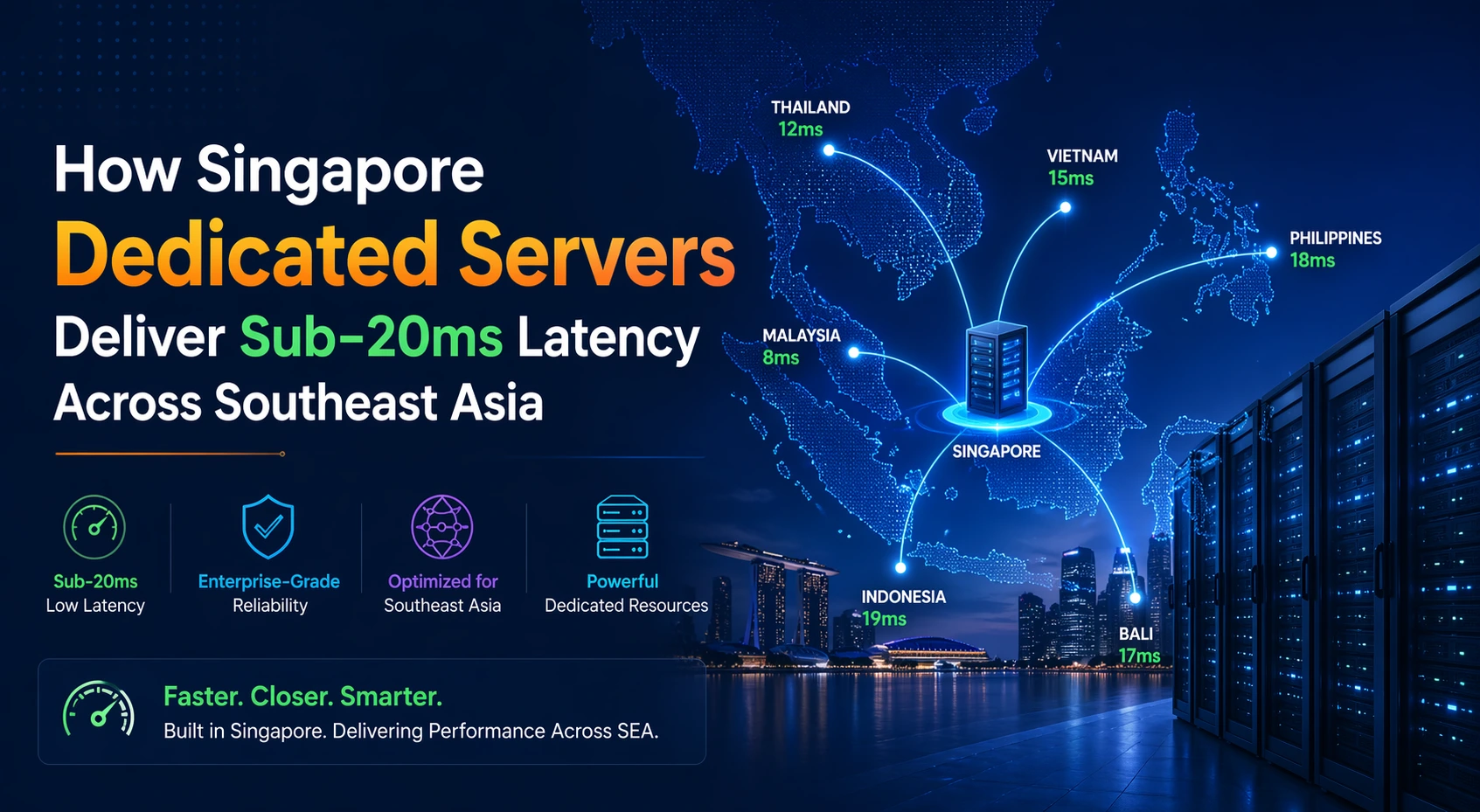
When you deploy an iDatam dedicated server in Singapore, here is a realistic breakdown of the ICMP ping latency you can expect to major Southeast Asian metropolitan hubs:
| Destination City | Expected Latency (RTT) | Network Routing Advantages |
|---|---|---|
| Kuala Lumpur / Johor Bahru, Malaysia | 2ms - 8ms | Direct high-capacity terrestrial fiber optics running across the Johor-Singapore Causeway. |
| Jakarta, Indonesia | 12ms - 18ms | Leaps across the Singapore Strait to Batam and down to Jakarta via dedicated subsea and terrestrial routes. |
| Ho Chi Minh City, Vietnam | 15ms - 25ms | Direct transit on the APG or AAE-1 cables allows for seamless real-time data streaming. |
| Bangkok, Thailand | 20ms - 30ms | Routing via terrestrial cables up the Malaysian peninsula or subsea links into the Gulf of Thailand. |
| Manila, Philippines | 30ms - 40ms | Direct SJC and APCN-2 optimizations bypass long trans-pacific routes, lowering latency dramatically. |
The Hardware Advantage: Why Dedicated Servers Matter
Even with the best submarine cables, a poor hosting environment can introduce application-level latency. When you rent a cloud VM, your application shares physical hardware with potentially dozens of other users. The hypervisor and virtual switch overhead can introduce milliseconds of jitter.
Dedicated servers eliminate this overhead:
-
Direct Hardware Access: The operating system interacts directly with the physical NIC. There is no hypervisor intercepting network packets.
-
No Noisy Neighbors: You have dedicated, uncontended access to the server's uplink port (typically 1Gbps or 10Gbps+).
-
Hardware Offloading: Modern dedicated servers utilize advanced features like SR-IOV and DPDK, pushing server-side network latency down to microseconds.
iDatam: Your Gateway to Southeast Asia
Building a robust data center presence and negotiating complex peering agreements in Singapore requires massive capital. iDatam’s Bare Metal Solutions simplify this by offering affordable, enterprise-grade dedicated servers.
By choosing an iDatam server, you secure a highly redundant BGP blend of top-tier upstream providers and direct local peering. If a specific submarine cable experiences degradation, our intelligent routing automatically shifts traffic to the next fastest route, ensuring your sub-20ms latency remains uninterrupted.
Leverage the world’s most advanced network infrastructure, bypass the bottlenecks, and deliver the lightning-fast experience your users demand with iDatam today.
iDatam Recommended Resources

Hardware
Why Are Intel, AMD, and Ampere Dominating the CPU Market?
When we choose a CPU, we had a lot to consider. However, the landscape of CPUs is mainly dominated by a few key companies depending on the market segment. No matter what kind of CPUs you're looking for, here's a breakdown of how things evolved and where they stand today.


Hardware
What is ARM?
ARM (Advanced RISC Machines) is a widely used family of RISC architectures developed by Arm Ltd., known for its energy efficiency and scalability. Since its founding in 1990, over 180 billion ARM-based chips have been shipped, making it the leading processor family globally.

Hardware
A Complete Guide to RAID Configurations: Balancing Performance and Data Protection
This guide digs into the world of RAID configurations, examining their advantages, disadvantages, and ideal use cases, as businesses and individuals increasingly seek ways to optimize their storage solutions in a data-driven world.
Discover iDatam Dedicated Server Locations
iDatam servers are available around the world, providing diverse options for hosting websites. Each region offers unique advantages, making it easier to choose a location that best suits your specific hosting needs.