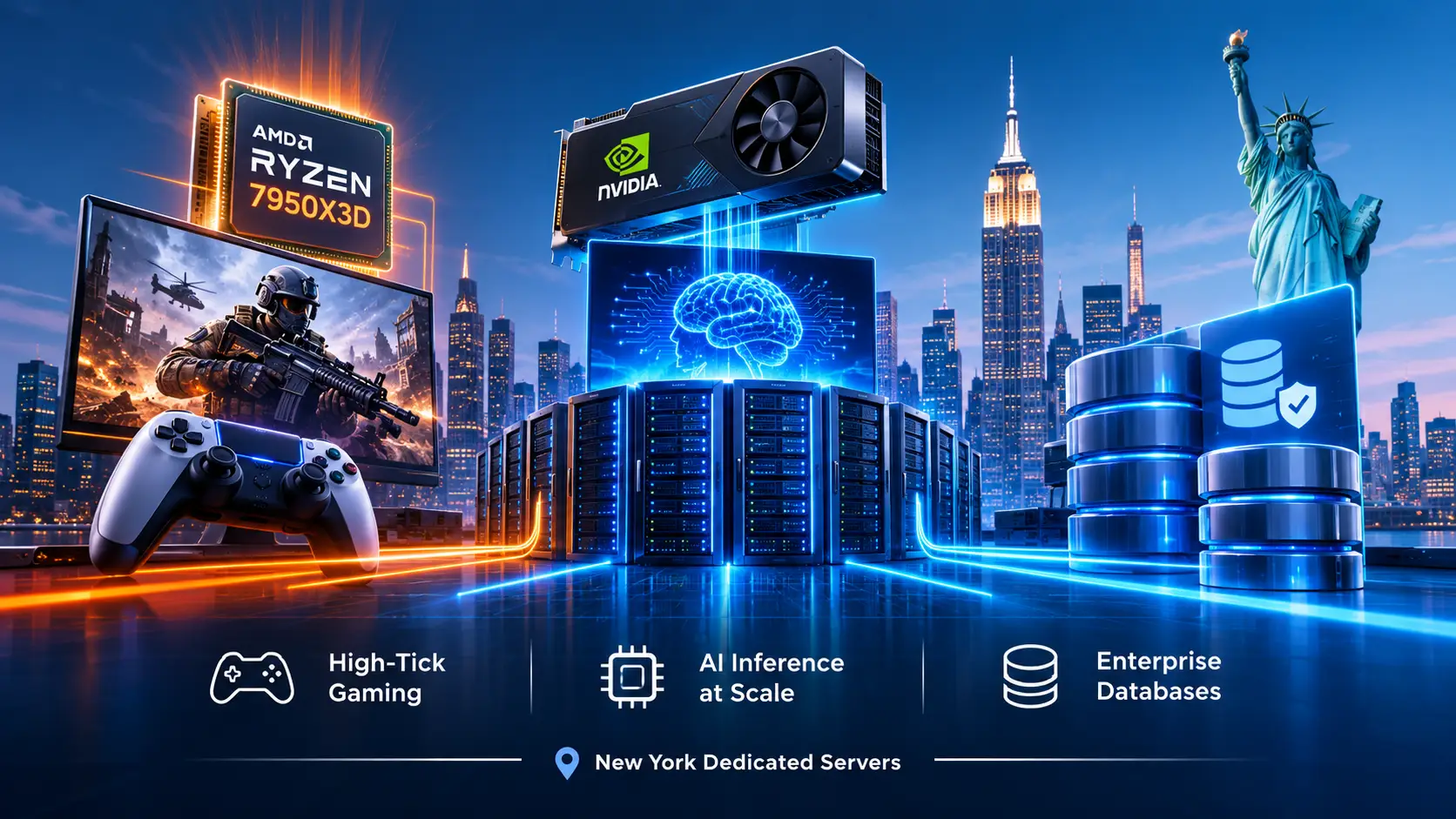
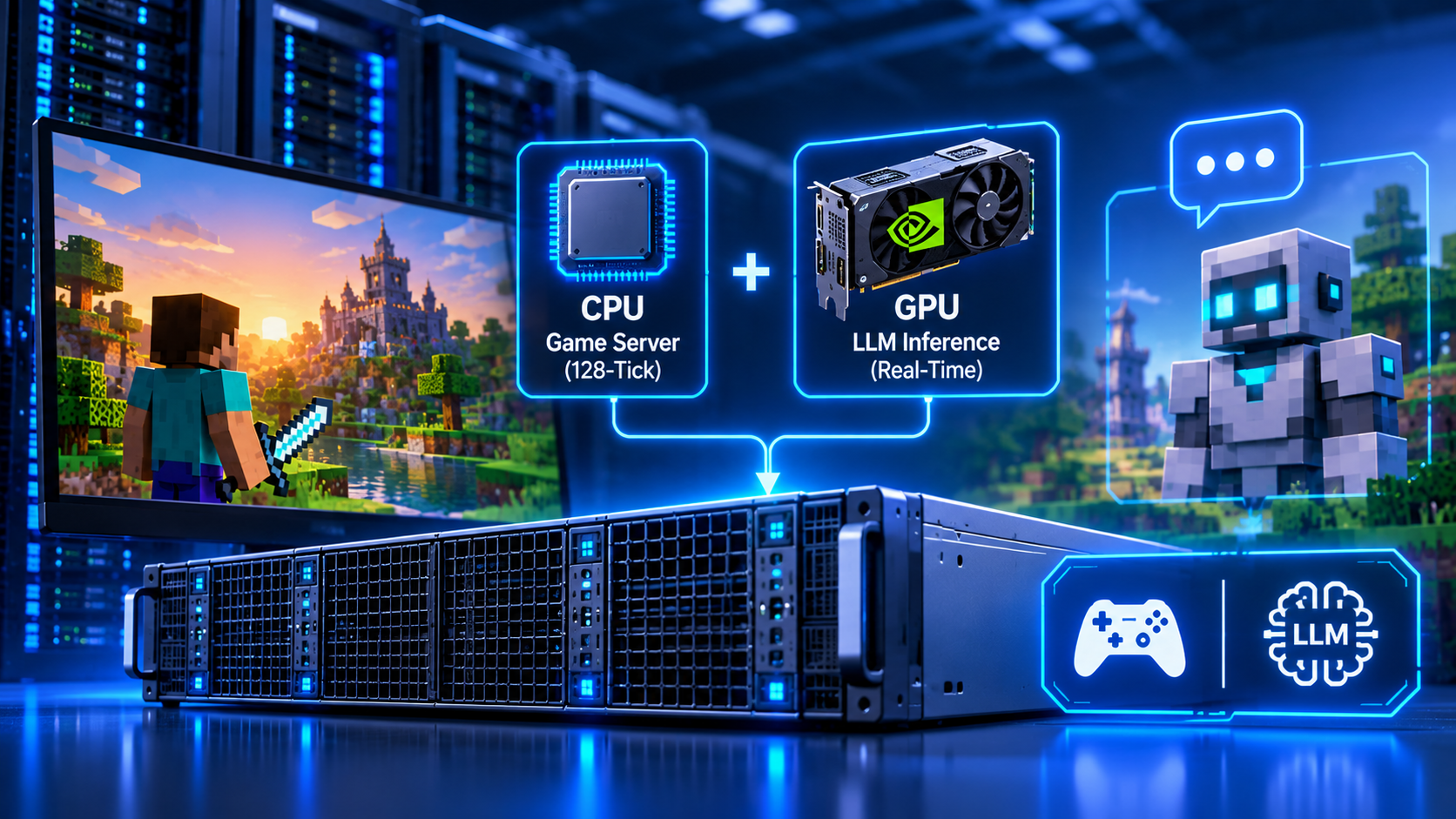
As enterprise applications and multiplayer games grow more complex, systems architects face a recurring challenge: the hardware required to run a real-time logical simulation is fundamentally opposed to the hardware required to run Generative AI or massive database warehousing.
Attempting to deploy a "one-size-fits-all" server to handle game state physics, LLM inference, and database writing inevitably results in CPU starvation, thermal throttling, and unacceptable latency spikes. Modern infrastructure requires workload isolation.
In this guide, we break down the three core mandates of high-performance architecture and the specific bare-metal configurations required to solve them.
The Single-Core Mandate: High-Tick Game Servers
Authoritative multiplayer game loops—such as those powering competitive FPS titles or dense survival games (like Rust)—are historically single-threaded. The server must process player inputs, calculate physics, and verify hitboxes sequentially.
The AMD Ryzen 7950X3D Advantage
When architects build gaming environments, clock speed and cache size matter more than total core count. The AMD Ryzen 7950X3D has become the gold standard for this exact workload.
3D V-Cache: By stacking memory directly on the processor, the CPU can store vast amounts of active spatial data (like player positions) without suffering the latency penalty of querying system RAM.
Peak Frequency: Capable of boosting up to 5.7GHz, it guarantees that 128-tick game loops (which require a full state calculation every 7.81 milliseconds) complete flawlessly.
The Parallel Mandate: AI & LLM Inference
Conversely, running AI models—whether for dynamic NPCs or enterprise data analysis—is an embarrassingly parallel workload. It does not require high clock speeds; it requires massive tensor computation and raw memory bandwidth.
If you attempt to run AI matrix math on a CPU (even a powerful Ryzen), generation speeds will drop to single-digit tokens per second, creating unusable latency for the end-user.
The IOPS Mandate: Enterprise Storage & Databases
The final pillar of a robust architecture is the persistence layer. Whether storing player profiles, transaction logs, or massive AI datasets, the bottleneck shifts from compute to Input/Output Operations Per Second (IOPS).
Dual Intel Xeon Gold with Enterprise SSDs
For heavy storage servers, single-core speed is irrelevant. You need PCIe lanes and raw memory capacity. A Dual Intel Xeon Gold setup (such as the 6122) provides upwards of 40 cores and supports massive 128GB+ DDR4 ECC memory arrays.
When paired with Enterprise SSDs in a Hardware RAID configuration, this architecture ensures zero data loss and prevents database write-locks during peak concurrent user (CCU) spikes.
The Edge Deployment Strategy: Minimizing Latency
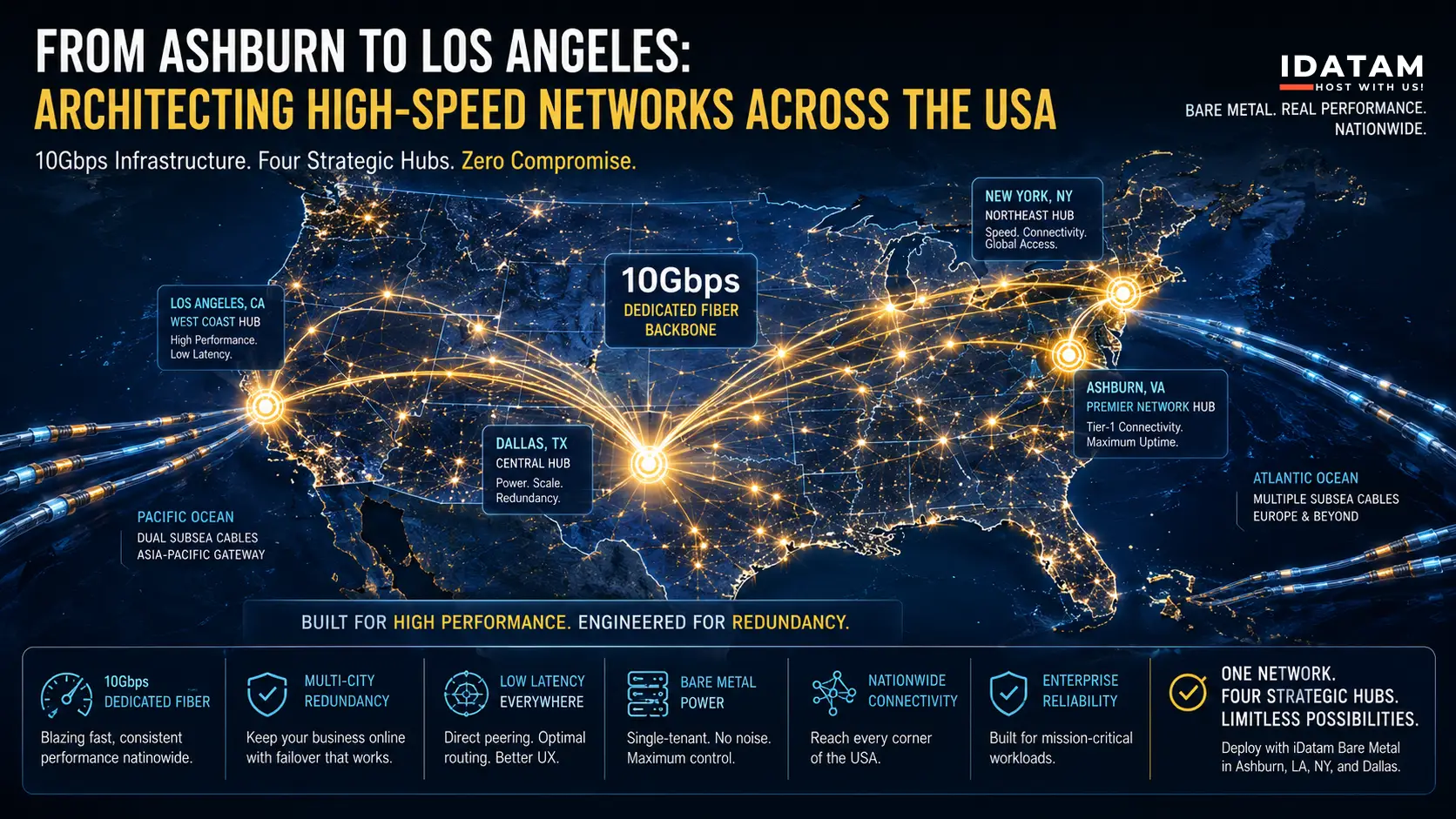
Even with perfect workload separation, geographical latency can ruin the user experience. You must deploy these distinct hardware profiles in the same physical data center to utilize 10Gbps+ local cross-connects.
For East Coast and transatlantic deployments, leveraging New York dedicated servers equipped with our specialized NVIDIA GPU, Ryzen Gaming, and Enterprise SSD profiles provides the ultimate edge advantage. By deploying your distinct workloads within the same NY facility, your game state engine can query your AI inference node and database cluster with sub-millisecond local latency, ensuring a seamless experience for your end users.
Frequently Asked Questions
iDatam Recommended Resources

Hardware
Why Are Intel, AMD, and Ampere Dominating the CPU Market?
When we choose a CPU, we had a lot to consider. However, the landscape of CPUs is mainly dominated by a few key companies depending on the market segment. No matter what kind of CPUs you're looking for, here's a breakdown of how things evolved and where they stand today.


Hardware
What is ARM?
ARM (Advanced RISC Machines) is a widely used family of RISC architectures developed by Arm Ltd., known for its energy efficiency and scalability. Since its founding in 1990, over 180 billion ARM-based chips have been shipped, making it the leading processor family globally.

Hardware
A Complete Guide to RAID Configurations: Balancing Performance and Data Protection
This guide digs into the world of RAID configurations, examining their advantages, disadvantages, and ideal use cases, as businesses and individuals increasingly seek ways to optimize their storage solutions in a data-driven world.