Today, forward-thinking enterprises, regional Software-as-a-Service (SaaS) providers, and industrial technology firms are completely rethinking their data center footprints. By expanding beyond the East Coast, organizations are tapping into a new era of localized infrastructure. This blog explores why the strategic deployment of Perth and Adelaide hosting solutions is no longer just an alternative, but a critical competitive necessity for companies looking to optimize Asia-Pacific (APAC) connectivity, reduce latency, and leverage the raw power of Australia dedicated hardware.
The Sydney Bottleneck and the APAC Proximity Challenge
To understand the rising demand for Western and Southern Australian infrastructure, one must first understand the physics of data transmission and the geographical realities of the Australian continent. Australia is an immense landmass. The distance from Sydney on the East Coast to Perth on the West Coast is approximately 3,300 kilometers. When data travels over terrestrial fiber optic networks, it is subject to the speed of light in glass, plus the processing delays introduced by routers, switches, and amplifiers along the route.
When an enterprise hosts its primary infrastructure in Sydney, any digital interaction originating from Western Australia, South Australia, or Southeast Asia must traverse this massive continental expanse. For a user in Singapore accessing a Sydney-based server, the data must travel down the coast of Australia, across the continent, and back up, resulting in round-trip times (RTT) that can easily exceed 100 to 130 milliseconds.
🌏 Active Submarine Cable Routes — Perth Hub
In an era where high-frequency trading, real-time analytics, autonomous industrial machinery, and responsive SaaS applications demand sub-50 millisecond or even sub-10 millisecond latency, this East Coast bottleneck is unacceptable. The geographical distance introduces unavoidable lag, degrading user experiences and stalling critical machine-to-machine (M2M) communications. This constraint has catalyzed a massive pivot toward localized hosting, pushing computation closer to the edge where the data is actually generated and consumed.
Perth: The Digital Gateway to Southeast Asia
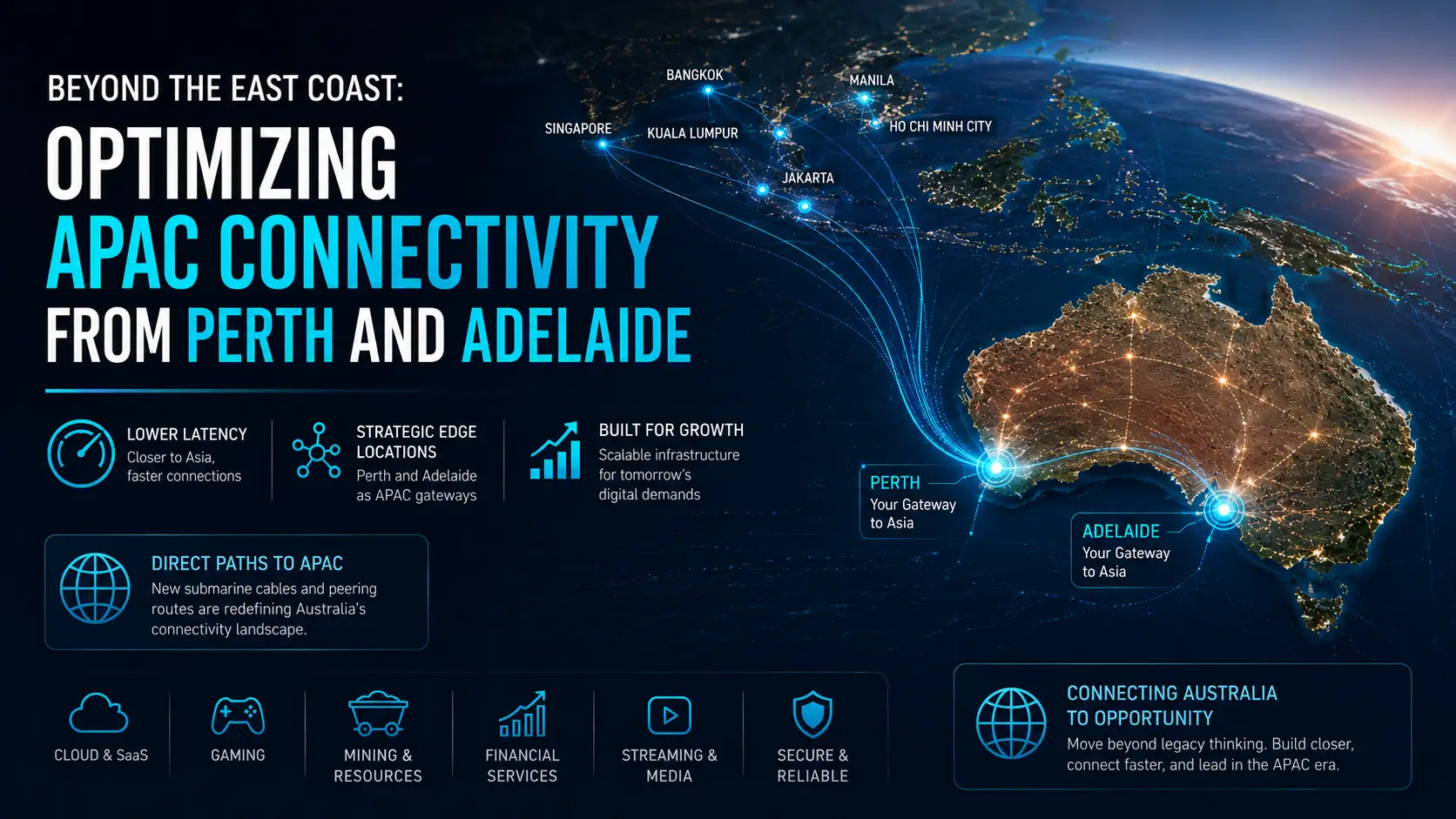
Perth is no longer just the isolated capital of Western Australia; it has transformed into a premier digital gateway connecting Oceania to the booming economies of Southeast Asia. This transformation is driven largely by significant investments in next-generation submarine cable systems.
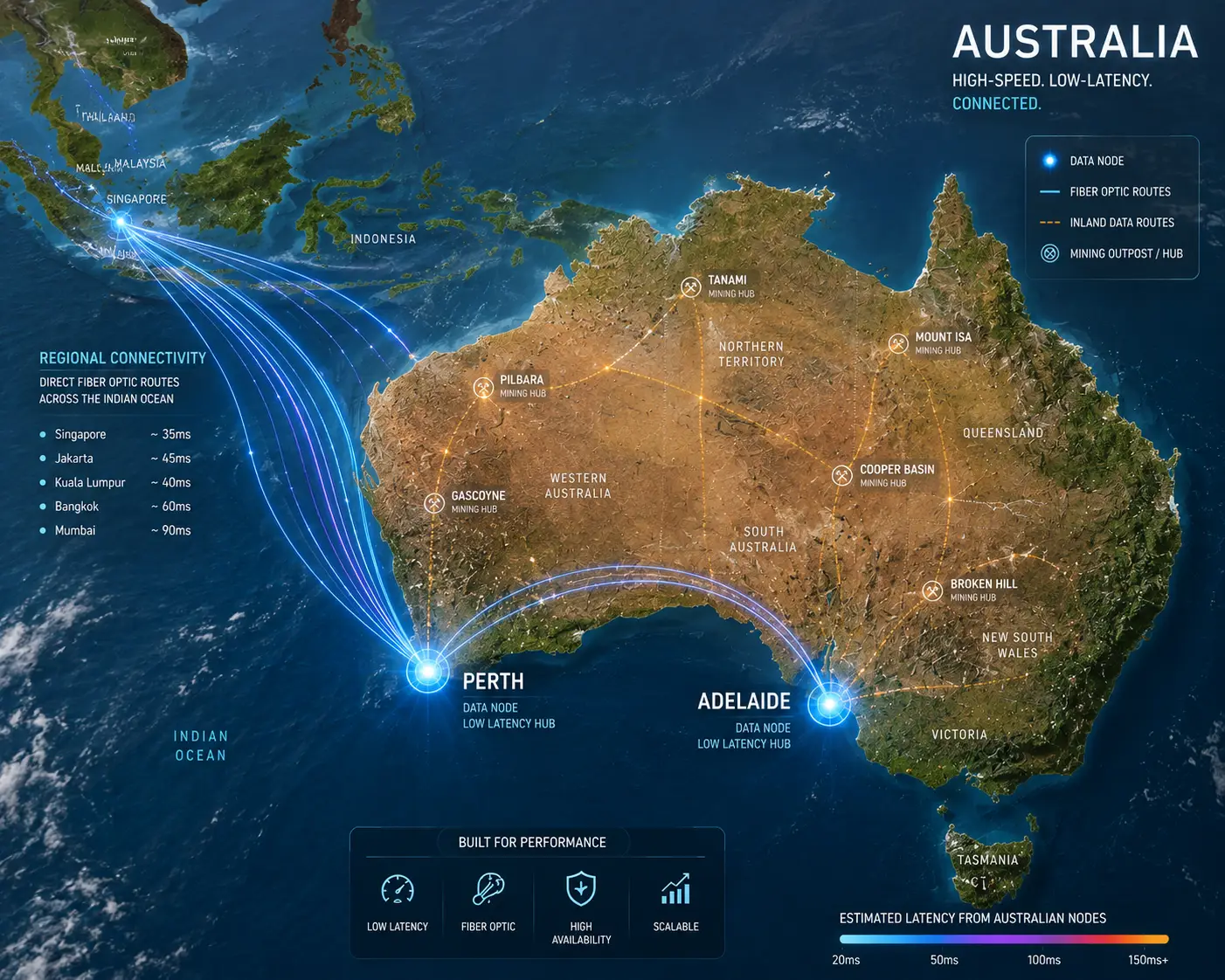
Historically, Internet traffic from Perth had to be backhauled to Sydney before heading overseas. Today, Perth boasts direct, high-capacity subsea routes to key APAC hubs. Systems like the Australia Singapore Cable (ASC), the INDIGO-West cable, and the Oman Australia Cable (OAC) have fundamentally redrawn the data map. These cables provide high-speed, direct links from Perth to Singapore, Jakarta, and beyond.
By leveraging infrastructure in Perth, businesses can achieve unprecedented latency reductions. Round-trip times from Perth to Singapore hover around 50 milliseconds—less than half the time it takes to route the same traffic from Sydney. For enterprises targeting the APAC market, this difference is transformative. Financial institutions executing rapid transactions, gaming companies requiring synchronized multiplayer experiences, and streaming platforms delivering high-definition content can all provide a vastly superior service by originating their data from the West Coast.
Furthermore, Perth offers a unique layer of geographical redundancy. By distributing workloads across both the East and West coasts, enterprises insulate themselves against catastrophic cable cuts or natural disasters that might temporarily cripple Sydney's connectivity. Perth provides an independent, highly resilient route to the global Internet, making it a cornerstone of modern disaster recovery and business continuity strategies.
Adelaide: The Strategic Hub of Southern Innovation
While Perth looks outward toward the Indian Ocean and Southeast Asia, Adelaide serves a distinct, highly strategic role as the technological anchor of Southern Australia. South Australia has aggressively positioned itself as a hub for innovation, defense contracting, space technology, and advanced manufacturing. The state's investment in the "GigCity" network has wired Adelaide with ultra-fast, gigabit-speed connectivity, fostering an ecosystem ripe for high-tech development.
Adelaide's central location makes it the perfect bridge between the East and West coasts. It acts as a vital transit node and a highly secure location for sensitive data storage. For organizations involved in defense, aerospace, and government contracting—industries heavily concentrated in South Australia—data sovereignty and strict compliance are non-negotiable. Hosting data locally in Adelaide ensures that sensitive information remains within specific jurisdictional boundaries, satisfying stringent regulatory frameworks while providing lightning-fast access to local research institutions and defense hubs.
- Direct access to ASC, INDIGO-West & OAC cables
- ~50ms RTT to Singapore vs. 115ms from Sydney
- Independent routing for East Coast redundancy
- Proximity to Pilbara mining belt for edge compute
- Tier III/IV facilities with 99.99% uptime SLA
- GigCity gigabit connectivity backbone
- Data sovereignty for defense & gov contracts
- Transit node bridging East & West coasts
- Proximity to space & aerospace industry cluster
- Competitive pricing vs. Sydney East Coast rates
Moreover, Adelaide is becoming a prime location for regional SaaS providers aiming to deliver localized user experiences. By positioning servers in South Australia, software companies can ensure that their clients in the region experience crisp, responsive application performance without the micro-stutters associated with fetching data from New South Wales or Victoria.
Powering the Mining Tech Revolution at the Edge
Perhaps the most compelling driver for the surge in demand for localized infrastructure in Western and Southern Australia is the rapid digitization of the mining and resources sector. Western Australia and South Australia are global heavyweights in the extraction of iron ore, gold, copper, and critical minerals essential for the green energy transition.
The modern mine site is no longer just a place of heavy machinery and manual labor; it is a highly sophisticated, data-driven environment. Mining companies are heavily investing in Autonomous Haulage Systems (AHS), remote-controlled drilling rigs, IoT-enabled predictive maintenance sensors, and real-time digital twins of their operational facilities. These technologies generate colossal volumes of data every single second.
⛏️ Mining Data Pipeline — Edge to Insight
Sending terabytes of operational telemetry from a remote mine in the Pilbara region of Western Australia all the way to a data center in Sydney for processing is highly inefficient and potentially dangerous. Autonomous vehicles require split-second decision-making capabilities. A delay of a few milliseconds in processing sensor data could result in catastrophic equipment failure or safety hazards.
This is where the demand for bare-metal, localized infrastructure skyrockets. By utilizing compute resources in Perth and Adelaide, mining tech companies can process data closer to the source. This edge-computing approach minimizes latency, reduces the bandwidth costs associated with long-haul data transit, and enables the real-time analytics required to optimize extraction yields and ensure worker safety.
Empowering Regional SaaS and Digital Sovereignty
The software industry has recognized that a "one-size-fits-all" approach to hosting is fundamentally flawed when serving a geographically expansive market like Australia. Regional SaaS providers—whether they are developing localized enterprise resource planning (ERP) systems, agricultural tech platforms for Southern Australian viticulture, or healthcare management software for regional hospitals—require infrastructure that mirrors their user base.
When a SaaS company utilizes Perth and Adelaide hosting solutions, they dramatically improve the Quality of Experience (QoE) for their end-users. Application load times decrease, database queries execute faster, and real-time collaboration tools function seamlessly.
Industries benefiting from localized SaaS hosting
Furthermore, digital sovereignty has become a paramount concern in 2026. Businesses and government entities are increasingly demanding that their data physically reside within their own state borders. This is driven by varying regional privacy legislations, corporate governance policies, and the desire to protect intellectual property from cross-jurisdictional complications. By offering localized data storage and processing capabilities in Western and Southern Australia, SaaS providers can confidently market their compliance with regional data sovereignty mandates, unlocking lucrative contracts with government agencies and highly regulated industries.
High-Performance Architecture: Moving Beyond Virtualization
To truly capitalize on the geographical advantages of Perth and Adelaide, companies must look beyond standard shared hosting or highly abstracted cloud environments. The intensive workloads of modern enterprise—whether it is real-time AI inference, massive database hosting, or the routing of highly sensitive financial data—require raw, unadulterated computing power.
This is where the deployment of Australia dedicated hardware becomes essential. Unlike virtual private servers (VPS) or public cloud instances where resources are shared among multiple tenants (leading to the "noisy neighbor" phenomenon and inconsistent performance), dedicated bare-metal servers offer single-tenant exclusivity.
| Feature | Shared Cloud (Sydney) | iDatam Bare Metal (Perth / Adelaide) |
|---|---|---|
| Latency to APAC | 100 – 130ms | ~50ms |
| Resource Exclusivity | Shared / Multi-tenant | Single-tenant bare metal |
| Noisy Neighbor Risk | High | None |
| Data Sovereignty | NSW jurisdiction only | WA / SA jurisdiction |
| NVMe Storage IOPS | Throttled / shared pool | Full dedicated IOPS |
| DDoS Mitigation | Add-on / extra cost | Native multi-layer |
| Uptime SLA | 99.9% | 99.99% |
For mining tech companies running complex simulations, dedicated hardware provides the sustained compute necessary without the overhead of a hypervisor. For SaaS providers managing massive SQL databases, the utilization of dedicated NVMe solid-state drives ensures maximum IOPS, eliminating database bottlenecks. When this hardware is strategically located in Perth or Adelaide, organizations achieve the ultimate combination: maximum computational performance fused with minimum network latency.
The iDatam Competitive Edge in Regional Connectivity
Navigating the complexities of regional infrastructure deployment requires a hosting partner with a deep understanding of the Australian telecommunications landscape and a physical footprint that extends beyond the traditional East Coast hubs. iDatam has strategically engineered its network to provide companies with an undeniable edge in regional latency and performance.
While competitors continue to herd their clients into congested Sydney data centers, iDatam recognizes the critical importance of geographical diversity. By offering premium Australia dedicated hardware deployed directly within highly secure, Tier III and Tier IV equivalent facilities in both Perth and Adelaide, iDatam empowers businesses to build bespoke, low-latency networks tailored to their specific operational needs.
The Bare-Metal Advantage
iDatam does not compromise on hardware specifications. The Perth and Adelaide hosting solutions provided by iDatam feature the latest generation of enterprise-grade processors from Intel and AMD, massive allocations of ECC RAM, and blazing-fast NVMe storage arrays. This raw compute capability is crucial for the resource-heavy demands of 2026, allowing clients to run complex virtualization clusters, massive data lakes, and high-traffic e-commerce platforms with absolute stability.
Uncompromising Security and Uptime
Operating in remote or regional areas does not mean sacrificing enterprise reliability. iDatam's facilities in Western and Southern Australia feature redundant power feeds, advanced environmental controls, and sophisticated fire suppression systems to ensure 99.99% uptime. Furthermore, iDatam integrates robust, multi-layered DDoS mitigation natively into its network, protecting critical regional infrastructure from the rising tide of volumetric cyberattacks. This ensures that SaaS applications remain online and mining telemetry flows uninterrupted, regardless of external threat vectors.
Scalability and Customization
Understanding that no two enterprise deployments are identical, iDatam offers profound customization. Whether an organization requires a single, high-frequency server for localized data caching in Adelaide, or a complex, multi-node clustered environment with private VLANs spanning from Perth to Brisbane, iDatam engineers bespoke architectures. This flexibility allows companies to scale their regional presence organically as their Western and Southern Australian operations expand, without being locked into rigid, predefined hardware configurations.
Bridging the Continental Divide
The notion that Australian digital infrastructure begins and ends on the East Coast is an outdated relic of the early internet era. As we navigate the complex, data-heavy realities of 2026, the strategic importance of edge computing, localized SaaS delivery, and ultra-fast Asian connectivity cannot be overstated.
Western and Southern Australia are no longer just the geographical fringes of the continent; they are the new epicenters of digital innovation. Perth stands as the ultimate launchpad into the digital economies of Southeast Asia, offering unparalleled submarine cable access and latency reduction. Adelaide has cemented its status as a highly secure, technologically advanced hub, perfectly positioned to bridge the continental divide and support sensitive governmental, defense, and industrial operations.
For industries driving the future of the economy—from the high-tech mining operators in the Pilbara to the agile software developers in South Australia—proximity to data processing is the ultimate currency. Every millisecond saved in network transit translates to faster autonomous reactions, smoother application performance, and superior end-user engagement.
To maintain a competitive advantage, organizations must audit their current network topologies and recognize the hidden costs of the Sydney bottleneck. By leveraging robust Australia dedicated hardware and strategically migrating workloads to specialized Perth and Adelaide hosting solutions, businesses can unlock untapped performance potentials.
Partnering with a provider like iDatam, which possesses the foresight, the physical footprint, and the technical acumen to execute complex regional deployments, ensures that your infrastructure is not merely keeping pace with the demands of 2026, but actively driving your business forward. The future of APAC connectivity is distributed, it is localized, and it is undeniably expanding beyond the East Coast.
iDatam Recommended Resources

Hardware
Why Are Intel, AMD, and Ampere Dominating the CPU Market?
When we choose a CPU, we had a lot to consider. However, the landscape of CPUs is mainly dominated by a few key companies depending on the market segment. No matter what kind of CPUs you're looking for, here's a breakdown of how things evolved and where they stand today.


Hardware
What is ARM?
ARM (Advanced RISC Machines) is a widely used family of RISC architectures developed by Arm Ltd., known for its energy efficiency and scalability. Since its founding in 1990, over 180 billion ARM-based chips have been shipped, making it the leading processor family globally.

Hardware
A Complete Guide to RAID Configurations: Balancing Performance and Data Protection
This guide digs into the world of RAID configurations, examining their advantages, disadvantages, and ideal use cases, as businesses and individuals increasingly seek ways to optimize their storage solutions in a data-driven world.
Discover iDatam Dedicated Server Locations
iDatam servers are available around the world, providing diverse options for hosting websites. Each region offers unique advantages, making it easier to choose a location that best suits your specific hosting needs.