Multiplayer game architecture is experiencing its most radical structural evolution since the transition from peer-to-peer networking to authoritative dedicated servers. The integration of real-time Generative AI—specifically Large Language Models (LLMs) and Small Language Models (SLMs) powering dynamic Non-Player Characters (NPCs)—has broken traditional game server design patterns.
Historically, game servers executed deterministic logic: calculating hitboxes, syncing player state vectors, updating physics engines, and selecting pre-scripted dialogue strings from an array. Today, next-generation multiplayer titles require NPCs that comprehend open-ended player voice inputs, evaluate complex tactical states, synthesize real-time decisions, and stream contextual dialogue back to the player with zero noticeable stutter.
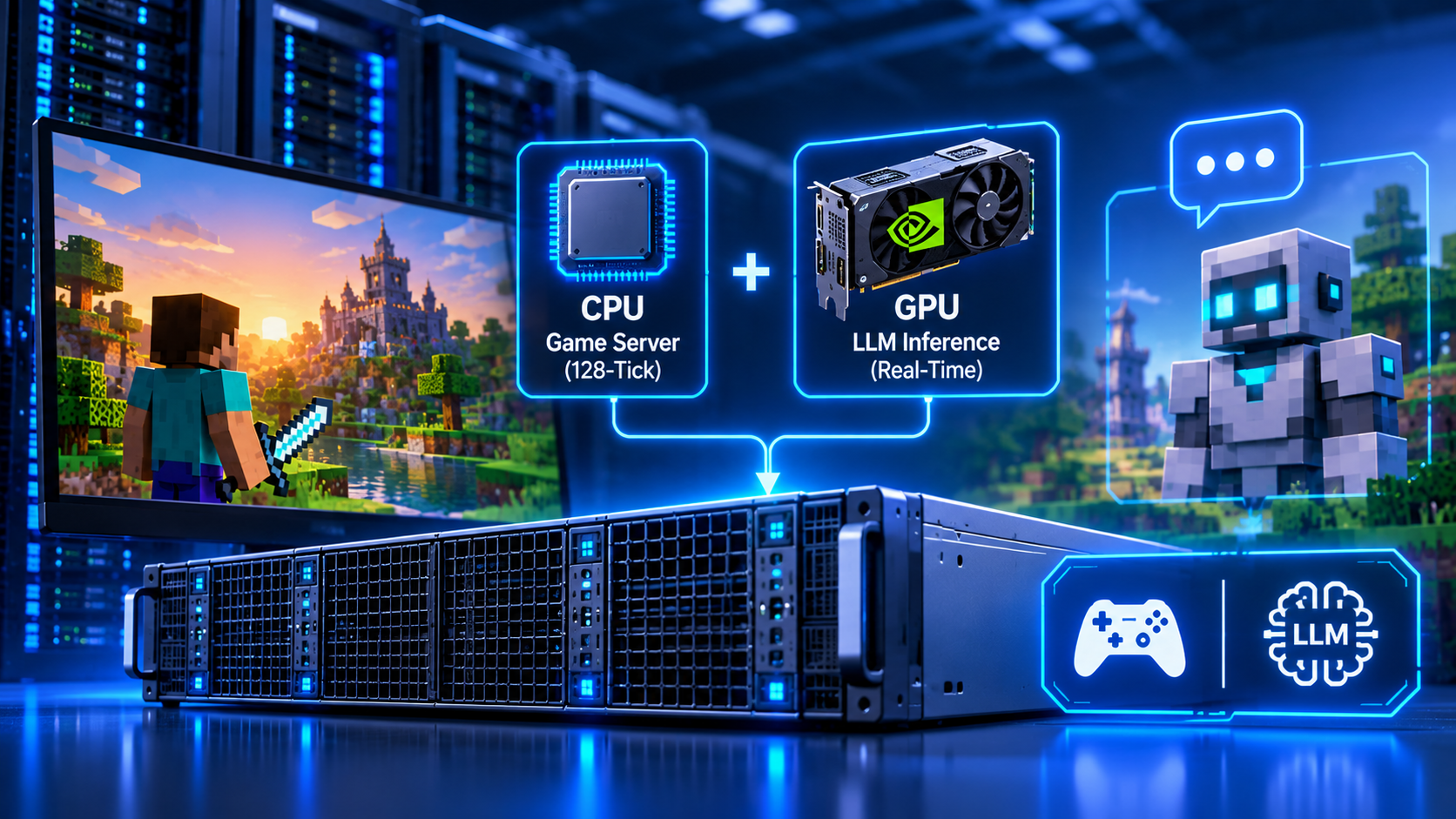
Achieving this level of immersion introduces a conflicting set of physical constraints. The game state loop demands ultra-high single-core CPU clock speeds to maintain strict 64-tick or 128-tick rate parity. Simultaneously, the LLM engine demands massive GPU tensor compute and extreme VRAM memory bandwidth to achieve sub-50ms Time-To-First-Token (TTFT) inference.
Attempting to run these dual workloads on public cloud virtual machines or relying on third-party commercial LLM APIs introduces latency spikes and cost inflation that ruin the gameplay experience. To build a commercial-grade, AI-integrated multiplayer title, studio architects must deploy a dedicated, hybrid bare-metal infrastructure stack.
The Physics of the Sub-50ms Latency Budget
To understand why traditional cloud hosting fails for LLM-powered games, you must analyze the strict temporal budget of a real-time multiplayer frame loop.
In an authoritative 128-tick multiplayer server (the gold standard for competitive tactical shooters), the server processes an entire world update every 7.81 milliseconds. At a 64-tick rate, that budget expands to 15.62 milliseconds. If the main thread blocks for even a fraction of a frame, players experience tick rate drops, rubber-banding, and desynchronization.
When a player interacts with an AI-driven NPC via voice or text, the interaction operates on a separate human perceptual threshold. Humans perceive conversational delay as unnatural if the gap between speaking and receiving a response exceeds 200 milliseconds. That 200ms total end-to-end latency budget must account for the four distinct phases outlined above.
If your LLM engine takes 800ms to generate its first token—a common latency profile when querying public cloud APIs over the public internet—the conversation feels sluggish, breaking player immersion. Furthermore, if the LLM inference engine runs on the same physical CPU cores as the game loop, it starves the game thread of cache and instruction cycles, causing catastrophic frame drops across the entire server instance.
Why Public Cloud APIs Fail in Production Multiplayer
Many game studios attempt to prototype AI-driven NPCs by routing game server events to external cloud APIs via standard HTTPS webhooks. While this works in isolated single-player playtests, it completely collapses under the load of a live multiplayer environment.
The Dual-Workload Dilemma: CPU Clock Speed vs. GPU Bandwidth
Solving this challenge requires recognizing that game state loops and LLM inference engines represent fundamentally opposite hardware paradigms.
The Game Engine Demand: Single-Thread CPU Frequency
Authoritative game servers (built on Unreal Engine, Unity, or custom C++ engines) are predominantly single-threaded or weakly multi-threaded. The core game loop—processing player movement, collision detection, line-of-sight calculations, and spatial partitioning—runs sequentially on a primary CPU core.
Extreme Base & Boost Clocks: CPU cores operating at 4.5GHz to 5.7GHz+.
Massive L3 Cache: Large instruction and data caches (such as AMD 3D V-Cache) to keep the core fed without polling system RAM.
Low Memory Latency: High-frequency DDR5 memory with tight timings to process state mutations instantly.
The AI Inference Demand: Parallel Compute & Memory Bandwidth
Conversely, LLM inference is an embarrassingly parallel, memory-bandwidth-bound workload. Running an open-weights model (such as Llama 3.1 8B, Qwen 2.5 7B, or Mistral 7B) requires reading billions of weight parameters from VRAM into execution units for every single token generated.
Massive VRAM Bandwidth: Memory buses capable of transferring data at 1,000 GB/s to 3,000+ GB/s.
High Tensor Core Density: Specialized matrix multiplication hardware to execute FP16, INT8, or INT4 quantized model weights.
Large VRAM Capacity: Enough contiguous video memory to hold the model weights alongside the KV Cache for hundreds of concurrent active conversations.
The Hybrid Bare-Metal Blueprint
To deliver low-latency multiplayer performance alongside real-time AI NPC inference, studio architects must deploy a two-tier, co-located bare-metal topology. Attempting to run a 128-tick game server on the CPU while simultaneously forcing the CPU to handle LLM matrix math results in total system lockup. The workloads must be physically separated at the hardware layer while remaining co-located on the same local network backbone.
- 128-Tick Game Loop Engine
- Spatial Physics & Hitboxes
- Authoritative Network Sync
- Local vLLM / TensorRT-LLM Engine
- Quantized 7B/8B LLM Weights
- Sub-50ms TTFT Context Engine
Tier 1: The Game State Compute Nodes
These dedicated servers host the core game instances. A single bare-metal chassis equipped with a high-frequency processor can host multiple isolated game server instances pinned to specific physical CPU cores.
CPU Selection: AMD EPYC 9374F (32 cores, up to 4.3GHz, massive L3 cache) or Intel Core i9-14900K / Xeon E-2400 series for maximum single-thread throughput.
OS Tuning: Custom Linux kernel compiled with CONFIG_PREEMPT_RT (real-time preempt) enabled, CPU frequency governors locked to performance, and explicit CPU core isolation to dedicate physical cores strictly to individual game processes.
Tier 2: The Local Inference Accelerator Nodes
Positioned in the exact same rack or local switch fabric, these dedicated GPU nodes run optimized containerized inference engines.
GPU Selection: NVIDIA L40S (48GB VRAM, 864 GB/s bandwidth), NVIDIA RTX 4090 (24GB VRAM for cost-optimized clusters), or NVIDIA H100 for massive multi-model deployments.
Host CPU & RAM: Multi-core AMD EPYC paired with 256GB+ System RAM to rapidly swap auxiliary context buffers and agent memory state into GPU VRAM.
The Interconnect: When an in-game event triggers an NPC decision, the Game State Node serializes the spatial state into a lightweight binary payload (e.g., FlatBuffers). The payload travels over the local 100Gbps switch directly to the AI Inference Node with a network transit time of <0.5 milliseconds. Total internal networking overhead remains virtually zero.
Model Quantization and Engine Optimization for Sub-50ms TTFT
Hardware is only half the equation. To hit sub-50ms TTFT on localized bare-metal GPUs, the software serving stack must be ruthlessly optimized.
1. Model Selection & Quantization (AWQ / GPTQ)
Running an unquantized FP16 (16-bit Floating Point) 7B parameter model requires ~14GB of VRAM just to store the weights, transferring 14GB of data across the memory bus per token. By applying AWQ (Activation-aware Weight Quantization) or GPTQ to compress the model to 4-bit (INT4), the memory footprint drops to ~4.5GB to 5.5GB without degrading conversational intelligence.
On an NVIDIA RTX 4090 featuring 1,008 GB/s of memory bandwidth, streaming a 5GB INT4 quantized model requires just ~4.9ms per token pass. This physical memory speed makes sub-50ms TTFT easily achievable.
2. PagedAttention and Continuous Batching
Standard LLM frameworks allocate static memory blocks for the KV Cache of every incoming request, leading to massive memory fragmentation. By utilizing frameworks powered by PagedAttention (like vLLM), the inference server partitions the KV Cache into virtual pages. This enables the GPU to manage hundreds of concurrent player conversations simultaneously on a single card.
3. Speculative Decoding
To speed up generation times even further, deploy Speculative Decoding. A tiny, hyper-fast "draft model" rapidly generates several draft tokens in a fraction of a millisecond. The primary 8B model then validates those tokens in a single parallel pass. This technique frequently yields a 2x to 3x speedup in generation output.
Financial Economics: Bare Metal vs. Public Cloud at Scale
To evaluate the commercial viability of hosting an AI-powered multiplayer game, we can model the monthly operational expenditure for a title maintaining a peak concurrency of 10,000 Concurrent Players (CCU), assuming 10% of the active player base is interacting with an AI-driven NPC at any given second (1,000 active concurrent AI streams).
| Cost Metric | Public Cloud API Route (e.g., Commercial 8B) | Dedicated iDatam Hybrid Bare-Metal Cluster |
|---|---|---|
| Billing Model | Metered per 1,000 Tokens (Input + Output) | Fixed Monthly Flat Rate (Unmetered Hardware) |
| Avg. Daily Tokens Processed | ~250 Million Tokens / Day | Unlimited (Hardware Maximum) |
| Estimated Monthly Cost | $15,000 - $22,000 / month (Variable) | $4,500 - $6,800 / month (Predictable) |
| Inference Latency Profile | Variable (200ms - 1,200ms TTFT) | Deterministic (<35ms - 50ms TTFT) |
| Data Privacy & Model Control | Third-Party Logging Risk / Public Model | 100% Private On-Premise / Custom Fine-Tunes |
By owning the bare-metal infrastructure layer, game studios reduce their monthly operating costs by 60% to 75%, while converting variable player usage costs into a fixed, predictable line-item expense.
Edge Deployment: Locating Infrastructure Near Your Player Base
To deliver a pristine multiplayer experience, latency must be minimized across every link in the chain—including the physical distance between the player's gaming rig and the data center.
Deploying your hybrid bare-metal cluster in a single centralized location forces players from other continents to suffer through high ping, neutralizing all the microsecond optimizations made at the GPU hardware layer.
A robust deployment strategy involves placing co-located Game Node + GPU Inference Node clusters across primary regional data center hubs:
North America: Ashburn (US-East) & Los Angeles / Dallas (US-Central/West)
Europe: Frankfurt (Central Europe) & London (UK/Transatlantic Routing)
Asia-Pacific: Singapore (Southeast Asia Hub) & Tokyo (East Asia Hub)
By anchoring your bare-metal server infrastructure in major peering exchanges with iDatam, you ensure sub-20ms network latency to player clients, reserving the remainder of your latency budget for complex physics, state sync, and real-time generative AI processing.
Building the Future of Interactive Gaming
Integrating Large Language Models into real-time multiplayer games represents a paradigm shift in player agency and world building. However, software innovation cannot bypass the laws of physics. Generative AI introduces massive compute and memory bandwidth demands that collapse traditional cloud hosting architectures.
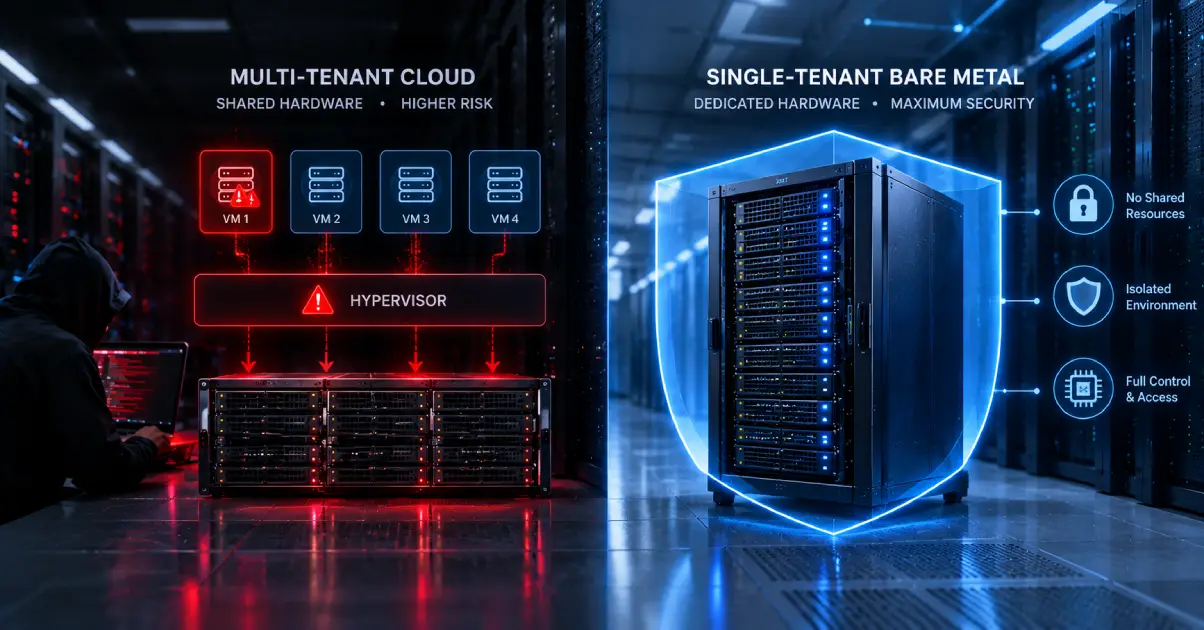
By deploying a dedicated, hybrid bare-metal stack—combining high-frequency CPU nodes for 128-tick game loops, localized bare-metal GPU nodes for sub-50ms LLM inference, and high-speed unmetered internal backplanes—studios can unlock continuous, lag-free AI interaction. Owning the physical hardware layer guarantees deterministic performance, protects against noisy neighbors, and provides the cost predictability required to scale next-generation multiplayer games to millions of players worldwide.
Frequently Asked Questions
iDatam Recommended Resources

Hardware
Why Are Intel, AMD, and Ampere Dominating the CPU Market?
When we choose a CPU, we had a lot to consider. However, the landscape of CPUs is mainly dominated by a few key companies depending on the market segment. No matter what kind of CPUs you're looking for, here's a breakdown of how things evolved and where they stand today.


Hardware
What is ARM?
ARM (Advanced RISC Machines) is a widely used family of RISC architectures developed by Arm Ltd., known for its energy efficiency and scalability. Since its founding in 1990, over 180 billion ARM-based chips have been shipped, making it the leading processor family globally.

Hardware
A Complete Guide to RAID Configurations: Balancing Performance and Data Protection
This guide digs into the world of RAID configurations, examining their advantages, disadvantages, and ideal use cases, as businesses and individuals increasingly seek ways to optimize their storage solutions in a data-driven world.
Discover iDatam Dedicated Server Locations
iDatam servers are available around the world, providing diverse options for hosting websites. Each region offers unique advantages, making it easier to choose a location that best suits your specific hosting needs.