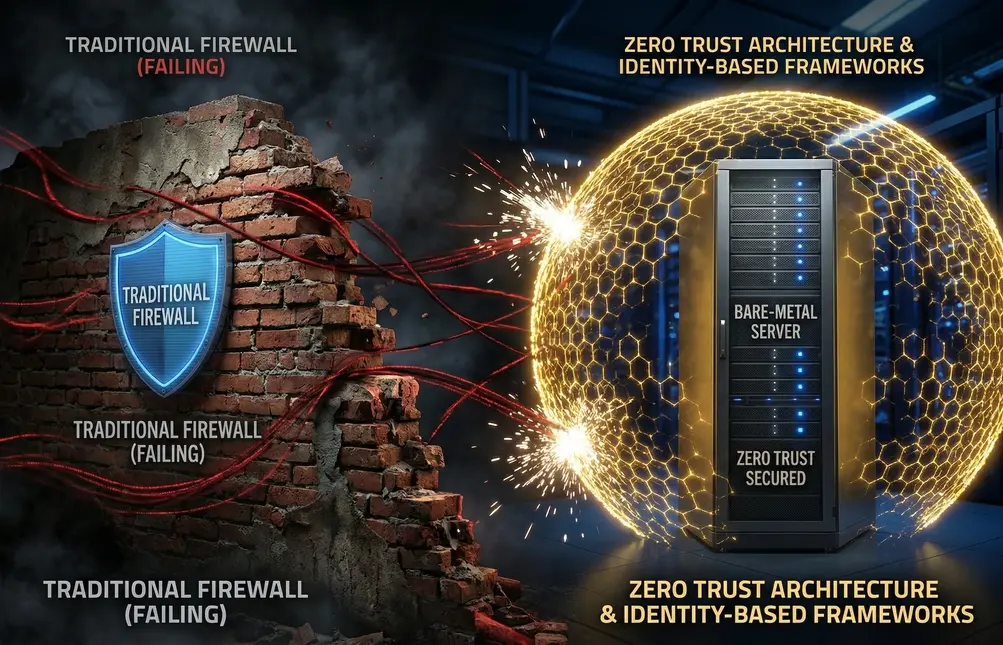
For decades, network security was built on a simple "castle and moat" philosophy. As long as you had a strong perimeter—usually a robust hardware firewall—everything inside the network was inherently trusted.
In 2026, that perimeter has evaporated.
Modern threats like polymorphic malware, advanced persistent threats (APTs), and compromised insider credentials have proven that the traditional "inside is safe, outside is hostile" mindset is fundamentally flawed. If you are relying solely on traditional firewall dedicated servers to protect your bare-metal infrastructure, you are effectively locking the front door but leaving all the interior doors wide open.
Here is why traditional perimeter defenses are failing, and why migrating to a Zero Trust architecture is the only way to secure modern dedicated hosting.
The Illusion of the Perimeter: Why VPNs and IP Whitelisting Fall Short
Historically, system administrators relied on Virtual Private Networks (VPNs) and IP whitelisting to control who could access a dedicated server. While these tools still have a place, they are no longer sufficient as a primary line of defense.
The Problem with VPNs: Traditional VPNs grant broad, network-wide access once a user authenticates. If a hacker manages to steal a remote worker's VPN credentials (a common occurrence via phishing or malware), they are granted a free pass straight through the firewall. Once inside, they can move laterally across your server environment without being challenged again.
The Problem with IP Whitelisting: IP whitelisting assumes that an IP address equals an identity. In a world of dynamic IPs, mobile workforces, and easily spoofed addresses, trusting traffic simply because of its origin point is a dangerous gamble.
Why Traditional Firewall Dedicated Servers Are Failing
A standard hardware or software firewall operates on static, rule-based logic (e.g., "Block port 22 to all except this subnet"). While blocking unauthorized ports is essential basic hygiene, it cannot stop modern, sophisticated attacks.
Blind to Encrypted Traffic: Over 90% of web traffic today is encrypted. Traditional firewalls struggle to inspect encrypted payloads without crushing the server's CPU performance. Because they can't see what's inside the packet, malicious payloads often slip right through open ports like 443.
No Protection Against Lateral Movement: If an attacker compromises a single vulnerable web application hosted on your server, the perimeter firewall is effectively bypassed. From there, the attacker can move laterally to database segments or root access without the firewall ever triggering an alarm.
Living-off-the-Land (LotL) Attacks: Hackers increasingly use legitimate, built-in system tools (like PowerShell or systemd) to execute attacks. Traditional firewalls view this as "normal" internal activity and fail to intervene.
The Zero Trust Shift: "Never Trust, Always Verify"
Zero Trust Architecture (ZTA) completely flips the old security model on its head. It operates on a single core assumption: a breach has already occurred, and no user, device, or packet can be trusted by default—even if they are already inside the network.
To secure a dedicated server in 2026, you must layer your firewall with identity-based, Zero Trust frameworks.
1. Continuous Identity Verification
Instead of a one-time VPN login, Zero Trust requires continuous authentication. Every single request to access an application, database, or API on the server must be authenticated, authorized, and encrypted. This relies heavily on Multi-Factor Authentication (MFA) at the OS and application levels, ensuring that identity is tied to the user and their specific device posture, not just a network location.
2. Micro-Segmentation
Instead of one flat network behind a firewall, Zero Trust breaks your dedicated server environment into tiny, isolated zones. By enforcing internal software-defined firewalls between different services (e.g., isolating the web server from the database server, even if they live on the same physical machine), you cut off an attacker's ability to move laterally. If one segment is breached, the infection is contained.
3. Least Privilege Access
Users and applications are granted only the absolute bare minimum permissions necessary to perform their exact task, and access is revoked immediately when the task is done. This prevents a compromised low-level account from being escalated to root access.
The Bottom Line
Traditional firewall dedicated servers are still a necessary foundational layer to deflect bulk, automated internet noise. However, they can no longer be your primary strategy. Protecting high-value bare-metal infrastructure in 2026 requires shifting from static perimeters to an intelligent, identity-driven Zero Trust model.
iDatam Recommended Resources

Hardware
Why Are Intel, AMD, and Ampere Dominating the CPU Market?
When we choose a CPU, we had a lot to consider. However, the landscape of CPUs is mainly dominated by a few key companies depending on the market segment. No matter what kind of CPUs you're looking for, here's a breakdown of how things evolved and where they stand today.


Hardware
What is ARM?
ARM (Advanced RISC Machines) is a widely used family of RISC architectures developed by Arm Ltd., known for its energy efficiency and scalability. Since its founding in 1990, over 180 billion ARM-based chips have been shipped, making it the leading processor family globally.

Hardware
A Complete Guide to RAID Configurations: Balancing Performance and Data Protection
This guide digs into the world of RAID configurations, examining their advantages, disadvantages, and ideal use cases, as businesses and individuals increasingly seek ways to optimize their storage solutions in a data-driven world.
Discover iDatam Dedicated Server Locations
iDatam servers are available around the world, providing diverse options for hosting websites. Each region offers unique advantages, making it easier to choose a location that best suits your specific hosting needs.