The digital architecture of the European Continent has reached a critical evolutionary milestone. As we navigate the dense, data-driven landscapes of 2026, the corporate rush toward abstracted public cloud environments has fundamentally shifted. Enterprises have come to realize that massive, hyper-scale cloud regions introduce significant challenges: unpredictable performance variance, complex pricing structures, and serious regulatory exposure. In their place, a distinct operational paradigm has emerged—one defined by single-tenant control, physical hardware optimization, and precise geographical positioning.
Within this updated framework, no single location holds more strategic value for European operations than Frankfurt am Main. Long recognized as the financial engine of Germany, Frankfurt has solidified its position as the undisputed center of European connectivity and data transmission.
For international enterprises, fast-scaling financial technology firms, and advanced artificial intelligence operations, deploying raw physical computing power in Hesse is no longer just an alternative configuration. It has become a core requirement for executing low-latency processing, meeting rigorous compliance standards, and establishing an unshakeable digital presence in mainland Europe. By moving beyond shared cloud footprints and anchoring core workloads onto single-tenant Germany dedicated infrastructure, forward-thinking organizations are securing a major competitive edge in raw speed, operational resilience, and legal compliance.
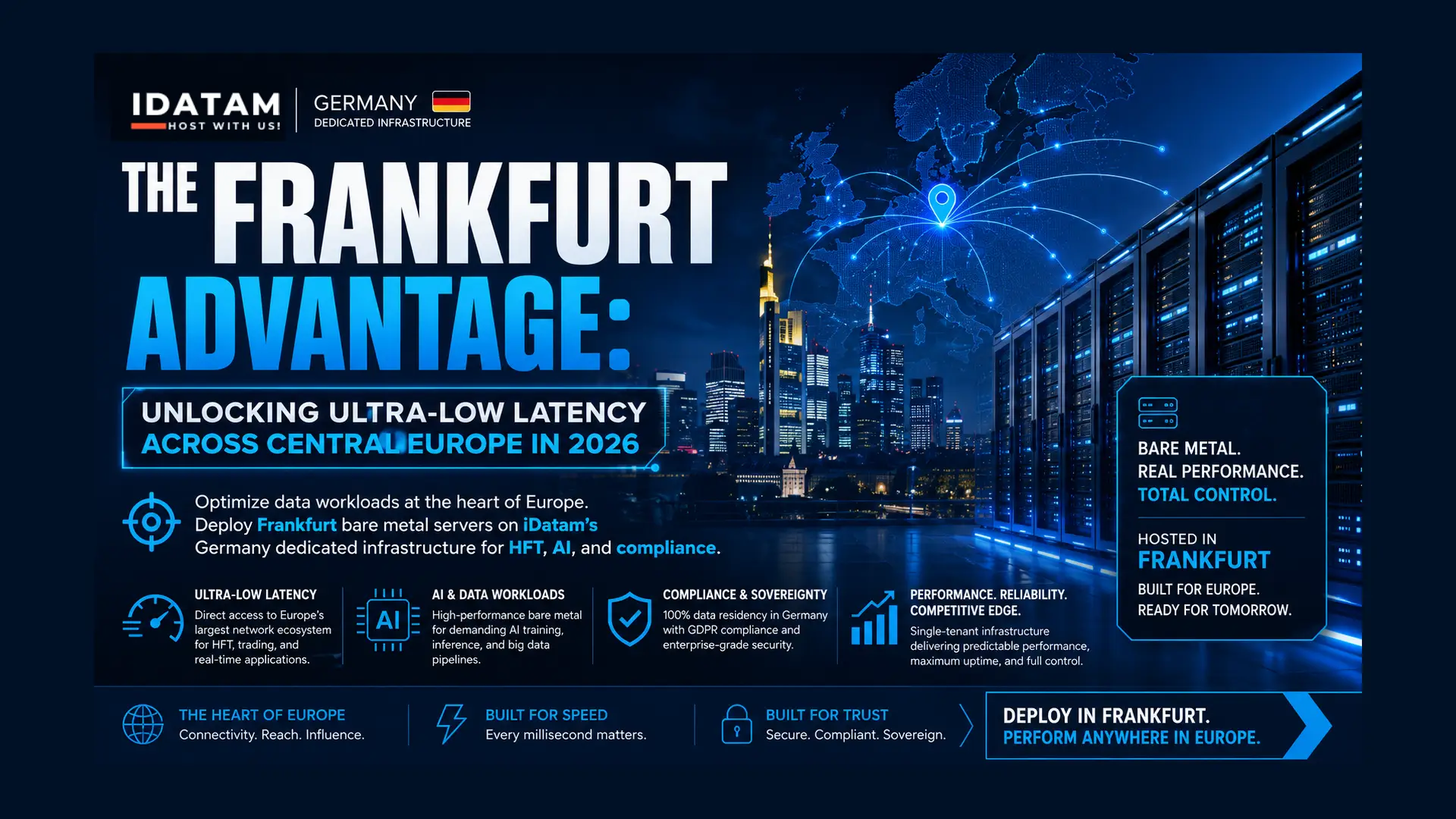
The Heart of European Connectivity: DE-CIX and Fiber Routing Physics
To understand why Frankfurt continues to dominate the European infrastructure landscape, one must look at the physical layout of global telecommunications lines and the mechanics of internet peering. Frankfurt is the home of DE-CIX (Deutscher Commercial Internet Exchange), which stands as one of the largest, most densely interconnected internet exchange points on the planet. In 2026, DE-CIX handles record-breaking volumes of peak data traffic, connecting thousands of independent networks, internet service providers (ISPs), global content delivery networks, and enterprise IT grids.
When an organization deploys infrastructure within this tightly grouped network hub, the structural path for data transit changes completely. In a standard network setup, data packet routing requires multiple intermediate hops across different networks, traversing third-party carriers and backhaul lines before reaching its destination. This introduces processing delays and increased network jitter.
Peering directly at the center of the European network fabric completely eliminates these unnecessary steps. Data packets leave the server and immediately transition onto the primary backbone networks of Europe. The physical distance from Frankfurt to other major European metropolitan zones—such as Paris, Amsterdam, London, Zurich, Prague, and Vienna—is perfectly optimized along direct underground fiber corridors.
                       ┌───────────────────────┐
                       │   Amsterdam Hub       │
                       │   (Low-Latency North) │
                       └───────────┬───────────┘
                                   │
  ┌───────────────────┐            │            ┌───────────────────┐
  │   Paris Hub       ├────────────┼────────────┤   Prague Hub      │
  │   (Western Route) │            │            │   (Eastern Route) │
  └───────────────────┘            ▼            └───────────────────┘
                       ┌───────────────────────┐
                       │   Frankfurt Core      │
                       │   (DE-CIX Intersect)  │
                       └───────────┬───────────┘
                                   │
                                   ▼
                       ┌───────────────────────┐
                       │   Zurich / Milan Hub  │
                       │   (Southern Corridor) │
                       └───────────────────────┘
This geographic proximity, combined with direct network peering, brings round-trip times (RTT) across Central Europe down to single-digit milliseconds. For any enterprise application where performance is tied directly to network speed, utilizing high-performance Frankfurt bare metal hardware provides an immediate, unyielding advantage that cannot be replicated from peripheral data regions.
The 2026 Workloads: High-Frequency Trading and AI Processing
The demand for localized, raw physical hardware in Frankfurt is being driven to new heights by two highly demanding technological sectors: High-Frequency Trading (HFT) and large-scale Artificial Intelligence (AI) production processing.
High-Frequency Trading Architecture
In the financial sector, where asset price updates fluctuate in millionths of a second, latency is the ultimate measure of success. Frankfurt houses the Boerse Frankfurt and the primary trading architectures of Eurex, making it the focal point for European financial transactions. HFT firms, algorithmic liquidity providers, and fintech clearinghouses cannot tolerate the unpredictable timing delays introduced by virtualized cloud layers.
A hypervisor introduces software-driven scheduling pauses as it distributes physical CPU cycles across multiple virtual instances. For an HFT system, this variance—known as latency jitter—can cause a trading script to miss critical execution windows. Deployed directly on unshared, single-tenant physical setups, automated trading systems achieve completely predictable execution speeds, allowing algorithms to interact with local financial exchanges at direct line-rate capacity.
Localized AI Inference and Vector Pipelines
Simultaneously, 2026 has seen a massive surge in the localization of artificial intelligence processing. While initial AI model training occurred in massive, centralized processing clusters, real-time AI inference—the process where an active application queries a model to generate instant responses, analyze live data streams, or automate corporate decisions—must happen close to the end-user.
Virtualized Multi-Tenant Stack:
[App Layer] ──> [Hypervisor Scheduling] ──> [Shared CPU/RAM] ──> Jitter & Variable Delay

Sovereign Bare Metal Stack:
[App Layer] ──────────────────────────────> [Exclusive Hardware] ──> Sustained Compute & Zero Jitter
Running intensive AI pipelines, real-time predictive analytics, and massive vector database queries requires continuous, unthrottled access to physical processing units, memory buses, and high-speed NVMe storage subsystems. When these compute workloads run on dedicated architectures directly connected to Europe's primary network exchange, businesses eliminate data retrieval bottlenecks. This ensures AI-powered services operate with the instantaneous response times modern consumers expect.
Navigating the Digital Fortress: German Privacy and 2026 Compliance
The selection of European infrastructure cannot be based on network performance alone; it must align perfectly with the continent's stringent regulatory landscape. Germany has long maintained some of the most rigorous data privacy frameworks in the world, enforced by the federal Bundesdatenschutzgesetz (BDSG) alongside the broader mandates of the European Union’s GDPR.
As we move through 2026, the compliance challenges for corporate data governance have grown significantly more complex due to two major regulatory developments:
The Comprehensive Enforcement of the NIS2 Directive: Bringing strict security management and immediate cyber incident reporting requirements to a vast array of essential and important entities operating within the European Union.
The Final phased Integration of the EU AI Act: Mandating complete, auditable traceability, data origin validation, and localized data isolation for artificial intelligence systems processing corporate and citizen telemetry.
For compliance officers, public cloud deployments introduce significant auditing difficulties. In a multi-tenant public cloud, data blocks are regularly fragmented, duplicated, and automatically redistributed across varying physical storage arrays—and sometimes across different national borders—to optimize provider storage efficiency. This lack of visible control makes passing an institutional compliance audit exceedingly difficult.
| Compliance Vector | Multi-Tenant Public Cloud | iDatam Dedicated Bare Metal |
|---|---|---|
| Data Boundary Mapping | Dynamic / Variable (Multi-Region Risk) | Static / Absolute (Fixed Physical Location) |
| Tenant Isolation | Logical (Software Hypervisor Layer) | Physical (Single-Tenant Enclosure) |
| Audit Capabilities | Limited (Abstracted Provider Control) | Complete (Full Access from BIOS to OS) |
| Hardware Ownership Visibility | None (Shared Virtual Resources) | Clear (Verifiable, Isolated Physical Components) |
| Regulatory Alignment | Complex Cross-Border Control Loops | Direct Compliance with BDSG, GDPR, & NIS2 |
By selecting single-tenant Germany dedicated infrastructure, organizations completely bypass these data compliance complications. When your security teams choose a private physical server, you establish a fixed physical boundary. Your database records, customer records, and processing loops remain completely contained within a specific, auditable machine enclosure inside the German jurisdiction. This clear operational transparency simplifies regulatory reporting, insulates your business from foreign data access claims, and satisfies the strict data protection rules required by European institutions.
Decentralizing the Grid: Frankfurt as the Core of a Regional Network
While Frankfurt remains the strategic center of Germany's digital economy, a resilient infrastructure strategy often requires broader geographic distribution. The modern enterprise model looks to Frankfurt as the primary high-speed transactional core, while utilizing specialized regional data nodes to build redundancy and handle localized processing requirements:
Berlin: The technology startup and public sector capital, ideal for localized application delivery, digital media distribution, and federal public sector platforms.
Dusseldorf: A crucial hub for industrial technology and telecom networks, managing real-time data flows for the surrounding Rhine-Ruhr corporate region.
Nuremberg and Falkenstein: Exceptional alternative routing pathways that offer cost-effective data replication and secure off-site backup zones outside the primary Frankfurt metropolitan area.
By establishing a central processing hub in Frankfurt and connecting it to these regional nodes, companies can construct highly resilient, completely compliant networks that ensure continuous availability across central Europe.
Technical Security: Inline Protection Against Mass Volumetric Attacks
As businesses become increasingly reliant on uninterrupted online access, the scale and complexity of cyber threats continue to escalate. In 2026, distributed denial-of-service (DDoS) campaigns have become standard tools for competitive disruption and international extortion. High-traffic web properties, financial APIs, and enterprise SaaS platforms operating within Germany face continuous scanning and targeted network attacks.
A standard software-based firewall running inside an application stack cannot defend against a modern volumetric attack. If an automated botnet targets your public IP address with hundreds of gigabits of garbage data, the physical network port becomes saturated long before your operating system can inspect or drop the malicious packets.
Defending critical infrastructure requires an enterprise-grade, hardware-accelerated mitigation network operating directly at the data center carrier edge. This system inspects incoming traffic at line-rate, dropping malicious requests before they can consume your dedicated bandwidth allocations:
[ Incoming Multi-Gigabit Attack ]
                │
                ▼
   ┌────────────────────────┐
   │ Inline Scrubbing Edge  │ <── Identifies and filters malicious traffic instantly
   └────────────┬───────────┘
                │
                ▼ (Pure, Authorized Data)
   ┌────────────────────────┐
   │ Frankfurt Bare Metal   │ <── Continues processing business tasks without lag
   └────────────────────────┘
This automated, multi-layered defense guarantees that even during a major, sustained volumetric attack, your core business databases, API gateways, and web environments remain perfectly stable and accessible to legitimate customers throughout the EU.
The iDatam Infrastructure Blueprint in Frankfurt
Deploying an enterprise-grade footprint that successfully balances low latency with rigorous data privacy requirements demands a reliable, highly capable infrastructure partner. iDatam has specifically engineered its presence in Germany to provide organizations with an unmatched combination of raw processing power, network reach, and technical support.
High-Performance Bare-Metal Inventory
iDatam’s Frankfurt bare metal configurations are engineered without compromise, built exclusively with high-end, modern components designed for continuous enterprise availability:
Advanced AMD EPYC and Intel Xeon Scalable processors featuring massive core counts to manage heavy parallel processing tasks.
Scalable, high-speed DDR5 ECC (Error-Correcting Code) memory setups that actively detect and repair memory errors before they can cause system instability.
Blazing-fast NVMe solid-state storage arrays, arranged in redundant hardware RAID setups to ensure extreme read/write speeds alongside data mirroring security.
Sovereign Control and Custom Networking
When you deploy with iDatam, your engineering teams secure full, root-level control and IPMI access from the hardware level up. There are no shared hypervisors, no abstracted control panels, and no unmonitored data transfers. Network links can be tailored to meet your precise performance requirements, featuring high-capacity uplinks and unmetered bandwidth options to handle massive data distribution without artificial cost penalties.
Resilient, Certified Environments
iDatam's physical infrastructure in Frankfurt is situated within premium, highly secure data center facilities that feature fully redundant power distribution loops, automated climate control systems, and advanced fire suppression technology. With multi-layered physical security checks and constant network monitoring, iDatam delivers the continuous availability and security compliance that modern enterprise operations require.
Securing Your Competitive Advantage in the European Market
The modern European digital economy rewards organizations that prioritize infrastructure performance, network speed, and legal compliance. Attempting to manage high-frequency financial platforms, sensitive corporate databases, or advanced AI inference tools within shared public cloud networks creates unnecessary latency penalties and serious compliance vulnerabilities.
Choosing localized, single-tenant configurations at the center of Europe's primary network exchange provides your business with an unshakeable operational foundation. By combining raw processing power with immediate proximity to global peering backbones, your applications can deliver the fluid, instantaneous experiences your users expect while remaining perfectly aligned with strict data governance mandates.
Do not allow your business performance to be limited by cloud virtualization layers or inefficient cross-border network routing. Explore iDatam’s complete line of Germany dedicated solutions and discover how custom-tailored Frankfurt bare metal systems can elevate your company's operational speed, digital security, and regulatory compliance across the European Union today.
iDatam Recommended Resources

Hardware
Why Are Intel, AMD, and Ampere Dominating the CPU Market?
When we choose a CPU, we had a lot to consider. However, the landscape of CPUs is mainly dominated by a few key companies depending on the market segment. No matter what kind of CPUs you're looking for, here's a breakdown of how things evolved and where they stand today.


Hardware
What is ARM?
ARM (Advanced RISC Machines) is a widely used family of RISC architectures developed by Arm Ltd., known for its energy efficiency and scalability. Since its founding in 1990, over 180 billion ARM-based chips have been shipped, making it the leading processor family globally.

Hardware
A Complete Guide to RAID Configurations: Balancing Performance and Data Protection
This guide digs into the world of RAID configurations, examining their advantages, disadvantages, and ideal use cases, as businesses and individuals increasingly seek ways to optimize their storage solutions in a data-driven world.
Discover iDatam Dedicated Server Locations
iDatam servers are available around the world, providing diverse options for hosting websites. Each region offers unique advantages, making it easier to choose a location that best suits your specific hosting needs.