Next-generation AI workloads have fundamentally broken traditional data center physics. With the arrival of NVIDIA’s Blackwell architecture and equivalent high-performance silicon, the enterprise hosting industry is slamming into a thermal wall. Managing a modern AI cluster is no longer just a software optimization challenge; it is a strict exercise in fluid dynamics and thermodynamics.
For decades, blowing chilled air across aluminum heatsinks was sufficient to keep enterprise hardware stable. Today, putting a 120kW server rack in a traditional air-cooled environment is a recipe for thermal throttling and hardware failure. As businesses race to deploy massive Large Language Models (LLMs) and real-time AI inference engines, understanding the physical realities of GPU server cooling is critical to maintaining uptime, extending hardware lifespan, and controlling operational costs.
The Physics of Thermal Design Power (TDP) Escalation
To understand why traditional data center cooling is failing, you have to look at the power consumption of modern silicon. Thermal Design Power (TDP) is the maximum amount of heat generated by a computer chip that the cooling system is designed to dissipate under any workload.
Just a few hardware generations ago, high-end enterprise GPUs hovered around 250W to 300W TDP. NVIDIA's Hopper architecture pushed this boundary to 700W with the H100. Now, NVIDIA Blackwell (such as the B200) shatters previous limits, pushing TDP past the 1,000W to 1,200W threshold per chip.
When you pack eight of these ultra-high-TDP GPUs into a single server node, and stack those nodes into a standard 42U rack, the localized heat generation is staggering. A single high-density AI server rack can now draw between 100kW and 120kW of power. Every watt of electrical power consumed by these processors is eventually converted into a watt of heat. Removing 120,000 watts of heat from a space roughly the size of a standard refrigerator requires a fundamental shift in cooling architecture.
The Limits of Traditional Air Cooling
Air cooling relies on Computer Room Air Conditioning (CRAC) units, precision HVAC systems, and hot-aisle/cold-aisle containment to manage temperatures. Cold air is pushed through the raised floor or front of the racks, where internal server fans force it across the CPU and GPU heatsinks. The hot air is then expelled out the back and returned to the cooling units.
The primary flaw in this system for AI workloads is the specific heat capacity of air. Air is a thermal insulator; it is highly inefficient at absorbing and transferring heat. To compensate for this physical limitation, data centers must drastically increase the volume and velocity of the air moving through the servers.
This creates three critical failure points for next-gen GPU servers:
The Density Wall: Traditional air cooling mechanisms physically max out around 30kW to 40kW per rack. Pushing beyond this requires custom containment and over-provisioned CRAC units that offer diminishing returns.
Parasitic Power Draw: To move enough air to cool a 40kW rack, server fans must spin at speeds exceeding 20,000 RPM. In these environments, the fans themselves can consume up to 20% of the server’s total power draw.
Structural Vibration: High-speed fans create micro-vibrations that degrade the lifespan of optical transceivers, NVMe storage drives, and interconnects over time.
Direct-to-Chip (D2C) Liquid Cooling: The New Standard
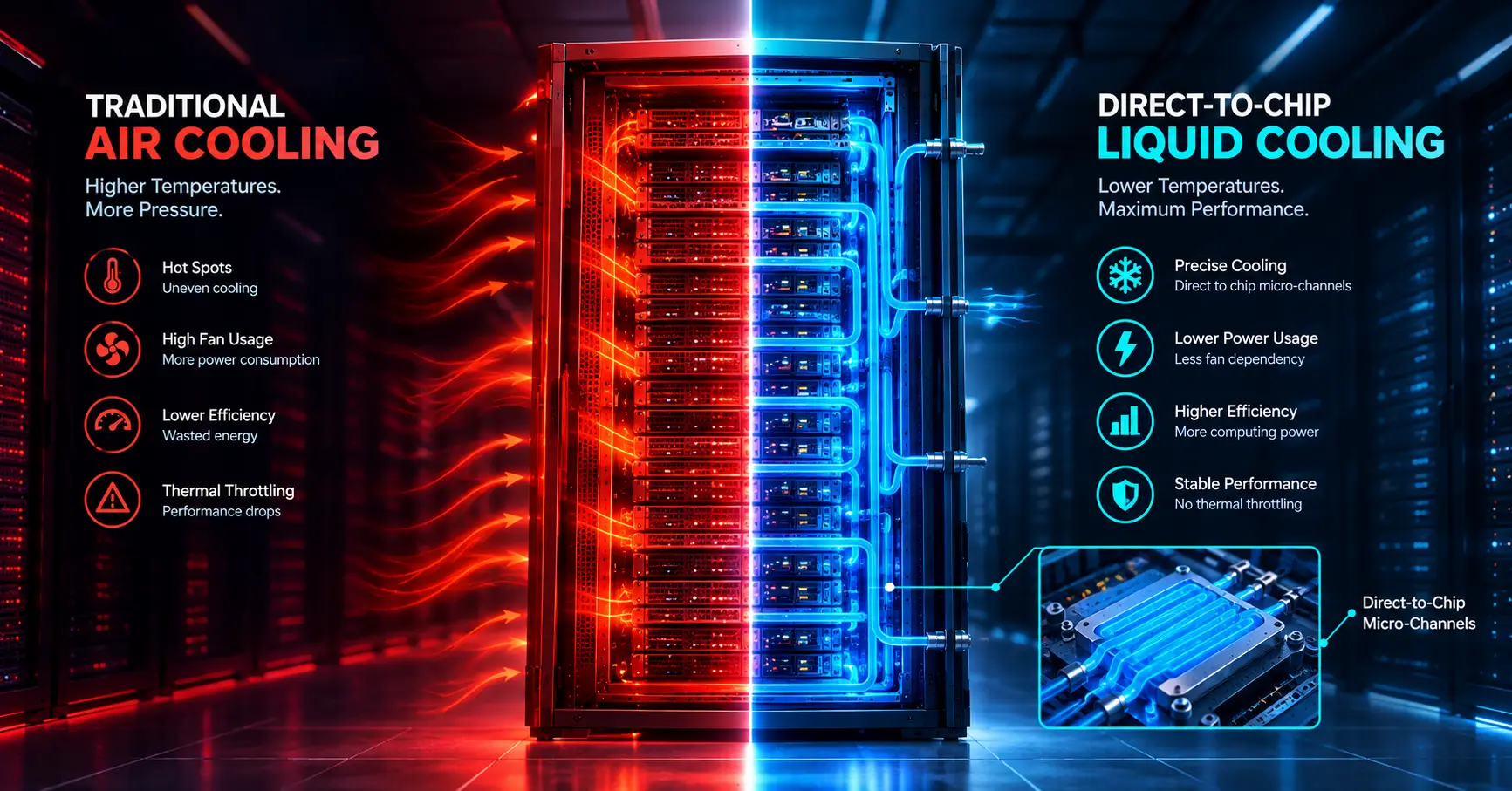
Liquid cooling bypasses the inefficiencies of air by leveraging the superior thermal capacity of liquid—typically water or engineered dielectric fluids. Liquid is approximately 3,000 times more effective at transferring heat than air by volume.
The most prominent implementation for modern AI infrastructure is Direct-to-Chip (D2C) liquid cooling. In a D2C system, micro-channel cold plates are mounted directly onto the GPU and CPU dies. A closed-loop system pumps chilled coolant through these cold plates, absorbing the heat at the exact point of generation.
Advantages of D2C Liquid Cooling for AI Servers
Precision Heat Capture: D2C cold plates capture 70% to 80% of the total server heat immediately. The remaining ambient heat (from memory modules and power supplies) is easily managed by low-speed chassis fans or rear-door heat exchangers (RDHx).
Zero Thermal Throttling: By maintaining strict, consistent temperatures across the silicon die, GPUs can sustain peak clock speeds indefinitely without engaging thermal throttling protocols. This ensures your LLM training times remain predictable.
Massive Rack Density: Liquid cooling allows data centers to safely deploy 100kW+ racks, maximizing the compute power per square foot and significantly reducing the physical footprint required for AI clusters.
The Impact on Power Usage Effectiveness (PUE)
Power Usage Effectiveness (PUE) is the standard metric for measuring data center energy efficiency.
A PUE of 1.0 represents a theoretically perfect data center where 100% of the power is used strictly for compute, with zero energy wasted on cooling or lighting.
Traditional air-cooled data centers generally operate at a PUE between 1.4 and 1.6. This means for every 100 watts of power used to run the servers, an additional 40 to 60 watts are wasted just keeping the environment cool.
When deploying thousands of high-TDP GPUs, a PUE of 1.5 translates to millions of dollars in wasted operational expenditure (OPEX). Direct-to-chip liquid cooling drastically reduces cooling overhead. By eliminating massive CRAC units and high-RPM server fans, liquid-cooled AI data centers routinely achieve a PUE of 1.05 to 1.15. For enterprise AI deployments, this level of electrical efficiency is not a luxury; it is the baseline requirement for maintaining profitability.
Comparing Liquid vs. Air Cooling for AI Infrastructure
| Metric | Air Cooling (HVAC/CRAC) | Direct-to-Chip Liquid Cooling |
|---|---|---|
| Max Rack Density limit | ~30kW to 40kW | 100kW+ |
| Coolant Thermal Capacity | Low (Requires massive volume) | Extremely High (~3000x of air) |
| Typical Data Center PUE | 1.4 - 1.6 | 1.05 - 1.15 |
| Parasitic Fan Power | Up to 20% of total draw | Less than 2% |
| Ideal Hardware | Standard CPUs, Entry-level GPUs | NVIDIA Blackwell, High-TDP silicon |
| Acoustics & Vibration | High noise, high component stress | Near-silent, zero vibration stress |
Architecting infrastructure for the 2026 AI landscape requires matching your hardware ambitions with physical reality. While air cooling remains perfectly viable for standard web servers, database hosting, and edge computing nodes, it cannot sustain the relentless TDP output of heavy-duty GPU clusters. Transitioning to bare-metal liquid-cooled infrastructure ensures that your enterprise maximizes computational throughput, mitigates hardware failure rates, and aggressively drives down the exorbitant power costs associated with next-generation AI workloads.
iDatam Recommended Resources

Hardware
Why Are Intel, AMD, and Ampere Dominating the CPU Market?
When we choose a CPU, we had a lot to consider. However, the landscape of CPUs is mainly dominated by a few key companies depending on the market segment. No matter what kind of CPUs you're looking for, here's a breakdown of how things evolved and where they stand today.


Hardware
What is ARM?
ARM (Advanced RISC Machines) is a widely used family of RISC architectures developed by Arm Ltd., known for its energy efficiency and scalability. Since its founding in 1990, over 180 billion ARM-based chips have been shipped, making it the leading processor family globally.

Hardware
A Complete Guide to RAID Configurations: Balancing Performance and Data Protection
This guide digs into the world of RAID configurations, examining their advantages, disadvantages, and ideal use cases, as businesses and individuals increasingly seek ways to optimize their storage solutions in a data-driven world.
Discover iDatam Dedicated Server Locations
iDatam servers are available around the world, providing diverse options for hosting websites. Each region offers unique advantages, making it easier to choose a location that best suits your specific hosting needs.