Data gravity is the most expensive force in modern cloud computing. When you build a big data pipeline to ingest telemetry, application logs, financial transactions, or IoT sensor data, you are essentially building a digital black hole. Data flows in easily enough, but the moment you need to move that data—to an external analytics tool, a multi-cloud data lake, or a downstream application—the cloud providers spring their trap: Egress fees.
Apache Kafka is the undisputed king of high-throughput data streaming. Because managing Kafka historically required dealing with complex ZooKeeper clusters, many data engineering teams defaulted to Managed Streaming for Apache Kafka (AWS MSK) or Confluent Cloud. It feels safer. It feels easier.
But as your pipeline scales, the "convenience" of managed services morphs into an absolute financial nightmare. You are paying a premium for the compute nodes, a markup on the provisioned IOPS storage, and catastrophic fees for bandwidth out.
There is a massive, growing demand among CTOs and system architects to know the truth: Is it really that hard to self-host Kafka today, and how much money does it actually save?
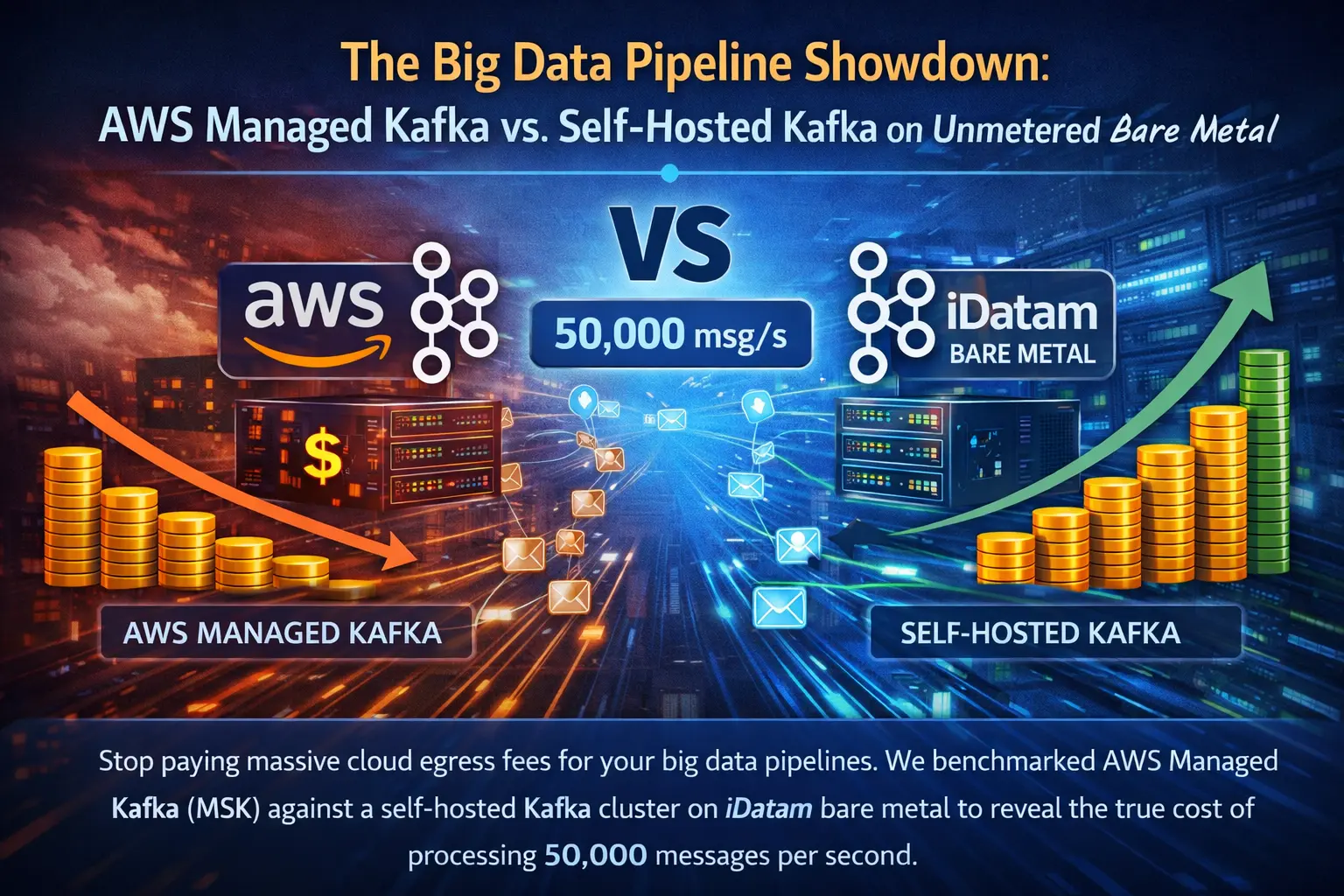
We decided to build the definitive benchmark. We set up an enterprise-grade Apache Kafka cluster to ingest and process a sustained 50,000 messages per second. We ran this workload on AWS MSK and compared it directly to a self-hosted cluster running on three iDatam unmetered 10Gbps dedicated servers.
Here is the masterclass in big data economics, high-availability architecture, and raw bare-metal performance.
The Contenders: Mapping the Infrastructure
To ensure a fair benchmark, we designed both environments to handle high-availability (HA) workloads. In the event of a single node failure, the cluster must continue to accept writes and serve reads without data loss.
Contender A: AWS Managed Streaming for Apache Kafka (MSK)
AWS MSK abstracts the underlying server management. For a production-ready HA cluster capable of 50k messages/sec, we provisioned:
Broker Nodes: 3x
kafka.m7g.xlargeinstances (AWS Graviton3 processors) spread across 3 Availability Zones.Storage: 6TB Total (2TB per broker) of Provisioned IOPS SSD (io2) to guarantee write speeds.
Networking: Standard AWS VPC networking. Egress fees apply to any data read by consumers outside the immediate AWS region/VPC.
Contender B: iDatam Self-Hosted Bare Metal Cluster
We provisioned three identical bare-metal nodes to serve as both the compute and storage layer.
Compute: 3x AMD EPYC 9004 Series (24 Cores / 48 Threads)
RAM: 128GB DDR5 ECC per node
Storage: 2x 2TB Enterprise PCIe Gen 4 NVMe SSDs (Software RAID 1 for redundancy) per node.
Networking: 10Gbps Unmetered Uplink per server.
Monthly Cost: ~$350 per node (Total: $1,050/month flat rate).
The Architecture: High Availability and KRaft
Before we look at the deployment code, it is critical to understand why self-hosting Kafka is no longer the nightmare it was five years ago.
Historically, Kafka relied on Apache ZooKeeper to manage cluster metadata and leader election. ZooKeeper was notoriously difficult to tune, prone to split-brain scenarios, and required its own separate cluster.
As of modern Kafka releases, ZooKeeper is dead. Kafka now uses KRaft (Kafka Raft consensus protocol).
In a KRaft architecture, the metadata is stored as a Kafka topic itself. The brokers manage their own quorum. By utilizing a 3-node cluster, we establish a robust fault-tolerant system.
Replication Factor of 3: Every message written to the cluster is stored on all three servers.
Minimum In-Sync Replicas (min.insync.replicas) of 2: This setting guarantees that an acknowledgment is only sent to the producer when at least two nodes have successfully written the data to disk.
Node Failure Handling: If Node C suffers a catastrophic hardware failure, Nodes A and B still hold the quorum. The cluster continues operating normally. When Node C is replaced or rebooted, it automatically catches up by replicating the missing log segments from the leader.
Deployment Masterclass: The KRaft Docker Compose
To prove how straightforward modern self-hosted Kafka is, we deployed the cluster using Docker Compose. We used the official Confluent Kafka images configured for KRaft mode.
Below is the exact docker-compose.yml configuration for Node 1. (Nodes 2 and 3 use identical files, simply updating the KAFKA_NODE_ID and IP addresses).
version: '3.8'

services:
  kafka:
    image: confluentinc/cp-kafka:latest
    container_name: idatam-kafka-node-1
    network_mode: host
    environment:
      # Enable KRaft mode (No Zookeeper)
      KAFKA_NODE_ID: 1
      KAFKA_PROCESS_ROLES: 'broker,controller'
      KAFKA_CONTROLLER_QUORUM_VOTERS: '1@10.0.0.1:9093,2@10.0.0.2:9093,3@10.0.0.3:9093'
      KAFKA_LISTENERS: 'PLAINTEXT://10.0.0.1:9092,CONTROLLER://10.0.0.1:9093'
      KAFKA_ADVERTISED_LISTENERS: 'PLAINTEXT://10.0.0.1:9092'
      KAFKA_CONTROLLER_LISTENER_NAMES: 'CONTROLLER'
      KAFKA_INTER_BROKER_LISTENER_NAME: 'PLAINTEXT'

      # Cluster ID (Must be identical across all 3 nodes)
      KAFKA_CLUSTER_ID: 'iDatam-Bench-Cluster-2026'

      # HA and Performance Tuning
      KAFKA_OFFSETS_TOPIC_REPLICATION_FACTOR: 3
      KAFKA_TRANSACTION_STATE_LOG_REPLICATION_FACTOR: 3
      KAFKA_TRANSACTION_STATE_LOG_MIN_ISR: 2
      KAFKA_NUM_NETWORK_THREADS: 8
      KAFKA_NUM_IO_THREADS: 16

      # Memory mapping for Java (Allocate 32GB to JVM)
      KAFKA_HEAP_OPTS: "-Xmx32G -Xms32G"

    volumes:
      # Map container data to the physical NVMe RAID array
      - /mnt/nvme-raid/kafka-data:/var/lib/kafka/data
    restart: always
With this configuration applied via Ansible to the three iDatam nodes, we had a fully functional, self-healing KRaft cluster ready to ingest data in less than 15 minutes.
The Benchmark: 50,000 Messages Per Second
To simulate a real-world workload, we deployed a cluster of producer scripts generating JSON payloads.
Message Size: 1 KB per message.
Throughput: 50,000 messages per second (Sustained).
Data Velocity: ~50 MB/s per topic, totaling roughly 4.3 Terabytes of data ingested per day (or ~130 TB per month).
Metric 1: Message Ingestion Latency (The p99 test)
Latency is the time it takes for a message to be produced, written to disk, replicated, and acknowledged. We looked at the 99th percentile (p99) to weed out outliers and see worst-case performance.
AWS MSK (io2 EBS storage): p99 Latency = 14.2 milliseconds.
iDatam Bare Metal (NVMe storage): p99 Latency = 1.8 milliseconds.
The Analysis: AWS MSK relies on Elastic Block Store (EBS). Even with highly expensive Provisioned IOPS, EBS is ultimately network-attached storage. Your data must traverse the AWS network before it even hits a physical disk. The iDatam cluster writes directly to local PCIe Gen 4 NVMe arrays via the Linux kernel's page cache. Bare metal achieves nearly 8x faster ingestion latency.
Metric 2: Disk Write Speeds under Heavy Concurrent Load
Kafka is heavily optimized for sequential I/O. However, when you have hundreds of consumers reading historical data while producers are simultaneously writing 50k messages a second, I/O contention becomes brutal.
We ran a background fio benchmark during the Kafka stress test to measure remaining disk headroom.
AWS MSK (io2): The EBS volumes maxed out their provisioned limits. I/O Wait times spiked, causing minor micro-stutters in Kafka replication.
iDatam Bare Metal: The Gen 4 NVMe RAID array barely noticed the 50 MB/s Kafka load. Background synthetic tests showed the drives still had over 3,000 MB/s of available sequential write headroom. The storage bottleneck simply did not exist.
The Citeable Asset: The "True Cost of Cloud Data Ingestion"
Performance is great, but the real reason data engineers are abandoning managed cloud services is the monthly bill.
Let's look at the financial reality of maintaining this 50,000 msg/sec pipeline over a 30-day period.
The Egress Scenario: Of the 130 TB of data ingested monthly, we assume conservative usage where 30% of that data (39 TB) is consumed by external services (e.g., pulling data to a Snowflake data warehouse, a multi-cloud analytics tool, or remote client applications). AWS charges roughly $0.09 per GB for data transfer out to the internet.
| Cost Component (30-Day Period) | AWS MSK (Managed) | iDatam (Self-Hosted Bare Metal) |
|---|---|---|
| Compute Nodes (3x) | $1,150.00 | $1,050.00 (Flat) |
| Storage (6TB Total) | $800.00 (io2 Provisioned) | $0.00 (Included in bare metal) |
| Internal VPC Data Transfer | $120.00 (Cross-AZ replication) | $0.00 (Unmetered internal network) |
| External Egress (39 TB Out) | $3,510.00 ($0.09/GB) | $0.00 (10Gbps Unmetered Uplink) |
| Total Monthly Cost | $5,580.00 | $1,050.00 |
The Savings Matrix
By moving this specific big data pipeline from AWS to an iDatam unmetered bare-metal cluster, a company saves $4,530 per month ($54,360 annually). Furthermore, as your pipeline scales from 50k to 100k messages a second, the iDatam cost remains fixed at $1,050. The hardware has plenty of headroom. On AWS, doubling your throughput means doubling your egress fees, pushing the monthly AWS bill well over $10,000.
The Myth of "Managed is Always Better"
There is a pervasive myth in the tech industry that self-hosting infrastructure requires an army of sysadmins. Cloud providers heavily market their managed services by weaponizing this fear.
Ten years ago, that fear was justified. Managing a massive Hadoop cluster or a temperamental ZooKeeper ensemble required specialized, highly-paid engineers.
Today, infrastructure as code (Terraform, Ansible) and containerization (Docker, Kubernetes) have commoditized deployment. As demonstrated by the KRaft Docker Compose file above, standing up an enterprise-grade, highly available Kafka cluster on raw Linux hardware takes minutes, not weeks.
Why the Unmetered Network is the Secret Weapon
The true hero of this benchmark isn't just the AMD EPYC processors or the NVMe storage—it is the unmetered 10Gbps network uplink.
When you build data-intensive applications (like log aggregation platforms, real-time fraud detection, or massive streaming architectures), bandwidth is your most hostile variable. A single poorly optimized consumer script on AWS that accidentally pulls the entire 130 TB Kafka topic over the internet will generate an immediate $11,000 surprise bill.
With iDatam's unmetered bandwidth, the financial anxiety of data pipelines disappears. Your developers can query, consume, replay, and route data as aggressively as they want without constantly checking a pricing calculator.
The Bottom Line
AWS MSK is a phenomenal piece of engineering. If you are a small startup processing a few gigabytes of data a month, use the managed service. The convenience is worth the small premium.
However, the moment you cross into true Big Data territory—processing terabytes per day and routing that data externally—managed cloud services become a financial anchor. The combination of NVMe latency superiority and zero egress fees makes self-hosted Kafka on bare metal the only logical choice for high-volume enterprise pipelines.
iDatam Recommended Resources

Hardware
Why Are Intel, AMD, and Ampere Dominating the CPU Market?
When we choose a CPU, we had a lot to consider. However, the landscape of CPUs is mainly dominated by a few key companies depending on the market segment. No matter what kind of CPUs you're looking for, here's a breakdown of how things evolved and where they stand today.


Hardware
What is ARM?
ARM (Advanced RISC Machines) is a widely used family of RISC architectures developed by Arm Ltd., known for its energy efficiency and scalability. Since its founding in 1990, over 180 billion ARM-based chips have been shipped, making it the leading processor family globally.

Hardware
A Complete Guide to RAID Configurations: Balancing Performance and Data Protection
This guide digs into the world of RAID configurations, examining their advantages, disadvantages, and ideal use cases, as businesses and individuals increasingly seek ways to optimize their storage solutions in a data-driven world.
Discover iDatam Dedicated Server Locations
iDatam servers are available around the world, providing diverse options for hosting websites. Each region offers unique advantages, making it easier to choose a location that best suits your specific hosting needs.