The global enterprise technology sector is experiencing a massive shift in how infrastructure is valued. For years, the primary metrics used to grade infrastructure deployments were raw computational power, network throughput, and point-to-point latency. While these elements remain crucial, a new operational requirement has emerged at the forefront of European IT strategy: environmental sustainability.
As we advance through 2026, the concept of green computing has evolved from a corporate social responsibility checkbox into a strict regulatory and operational requirement. This change is felt nowhere more intensely than in France.
As the second-largest economy in the European Union and a vital crossroads for continental fiber routing, France has positioned itself at the vanguard of the eco-friendly digital transition. For organizations running resource-heavy applications—such as real-time artificial intelligence inference, dense e-commerce processing arrays, or high-throughput Software-as-a-Service (SaaS) platforms—the historical approach of scaling blindly via multi-tenant public clouds is hitting a physical and regulatory wall. Public cloud providers frequently obscure the true carbon footprint and water consumption profiles of their workloads, leaving enterprise compliance officers exposed as new European disclosure laws come into full effect.
The modern answer to this challenge lies in a strategic return to single-tenant, private physical environments optimized for resource efficiency. By shifting workloads onto modern, single-tenant physical assets located directly within the French capital, organizations can achieve a rare balance: accessing elite computing speeds while staying ahead of strict environmental mandates. Leveraging tailored Paris dedicated environments allows forward-thinking enterprises to decouple from unpredictable multi-tenant cloud setups and build an unshakeable, sustainable digital presence in the heart of Europe.
The 2026 French Regulatory Landscape: Navigating the DDADUE Law
To successfully scale any digital service within France today, an enterprise must align perfectly with an aggressive local regulatory framework. The primary driver of this shift is the comprehensive implementation of the DDADUE Law (Dispositions d'Adaptation au Droit de l'Union Européenne), which officially transposed the European Union’s revised Energy Efficiency Directive (EED) into French national law. With its strict implementing decrees (including Decree No. 2025-1382) fully active since January 1, 2026, the legal expectations placed on data processing operations have changed fundamentally.
Under the current rules, any company utilizing data center infrastructure with an installed IT power capacity equal to or exceeding ≥ 500 kW must submit a comprehensive, audited transparency report by May 15 of every year. This annual submission requires detailed reporting on critical environmental and sustainability metrics from the previous calendar year, including:
Exact annual power consumption figures.
The explicit share of energy sourced from verified renewable generation assets.
Verified Power Usage Effectiveness (PUE) baselines.
Total water volume consumed exclusively for infrastructure cooling.
The specific proportion of captured waste heat that is successfully recovered and repurposed.
Furthermore, for facilities with an operational capacity exceeding > 1 MW, the DDADUE framework introduces mandatory waste heat recovery obligations. Operators must achieve an Energy Reuse Factor (ERF) of at least 0.2, meaning a minimum of 20% of the thermal waste generated by processing units must be captured and actively piped into external public or private heating networks, such as municipal residential heating grids or adjacent industrial facilities. Non-compliance is met with public formal notices and significant administrative fines of up to €50,000 per instance.
Simultaneously, the European Commission is rolling out its standardized data center rating scheme and energy efficiency labeling package. This framework makes infrastructure efficiency visible to the public, allowing B2B buyers to instantly compare the carbon profiles of competing services.
For international enterprises, these regulations turn multi-tenant public cloud deployments into compliance challenges. When data workloads are dynamically shifted across a distributed cloud grid, tracking and verifying exact energy and water metrics for a specific corporate database becomes virtually impossible.
Transitioning to verified France hosting services based on single-tenant bare metal solves this tracking dilemma entirely. By moving to a private physical architecture, your compliance teams gain access to an isolated, easily auditable environment. You can map out every kilowatt-hour consumed, verify the renewable origin of your power supply, and generate the clean data required to satisfy both the DDADUE mandates and broader corporate sustainability metrics.
Disproving the Performance Myth: The Engineering of Eco-Efficient Hardware
For years, a persistent misconception circulated within engineering circles: the idea that choosing sustainable, eco-friendly infrastructure required a compromise in raw processing power. In the legacy era of computing, keeping energy consumption low often meant deploying low-frequency processors or introducing aggressive power throttling that degraded application responsiveness under heavy user traffic.
In 2026, the engineering reality is entirely different. The rapid rise of artificial intelligence and machine learning pipelines has pushed server rack power densities to unprecedented levels. While a legacy enterprise server rack typically pulled between 20 to 40 kilowatts of power, modern AI-focused configurations routinely operate at 200 to 400 kilowatts per rack. Managing these intense compute loads sustainably requires optimization at the component level, rather than artificial performance restrictions.
| Infrastructure Feature | Legacy Multi-Tenant Hardware | Modern Eco-Efficient Bare Metal |
|---|---|---|
| Cooling Architecture | Standard Air-Chilled Raised Floors | Direct-to-Chip Liquid Cooling Loops |
| Power Distribution | Centralized, High-Loss Conversions | High-Efficiency Native DC Busways |
| Processor Generation | Oversubscribed, Older Architecture | High-Density AMD EPYC & Intel Xeon |
| Average Target PUE | 1.6 – 1.9 (Highly Variable) | 1.2 – 1.3 (Sustained and Auditable) |
| Data Tracking Clarity | Extrapolated Provider Estimates | Direct Physical Metric Reporting |
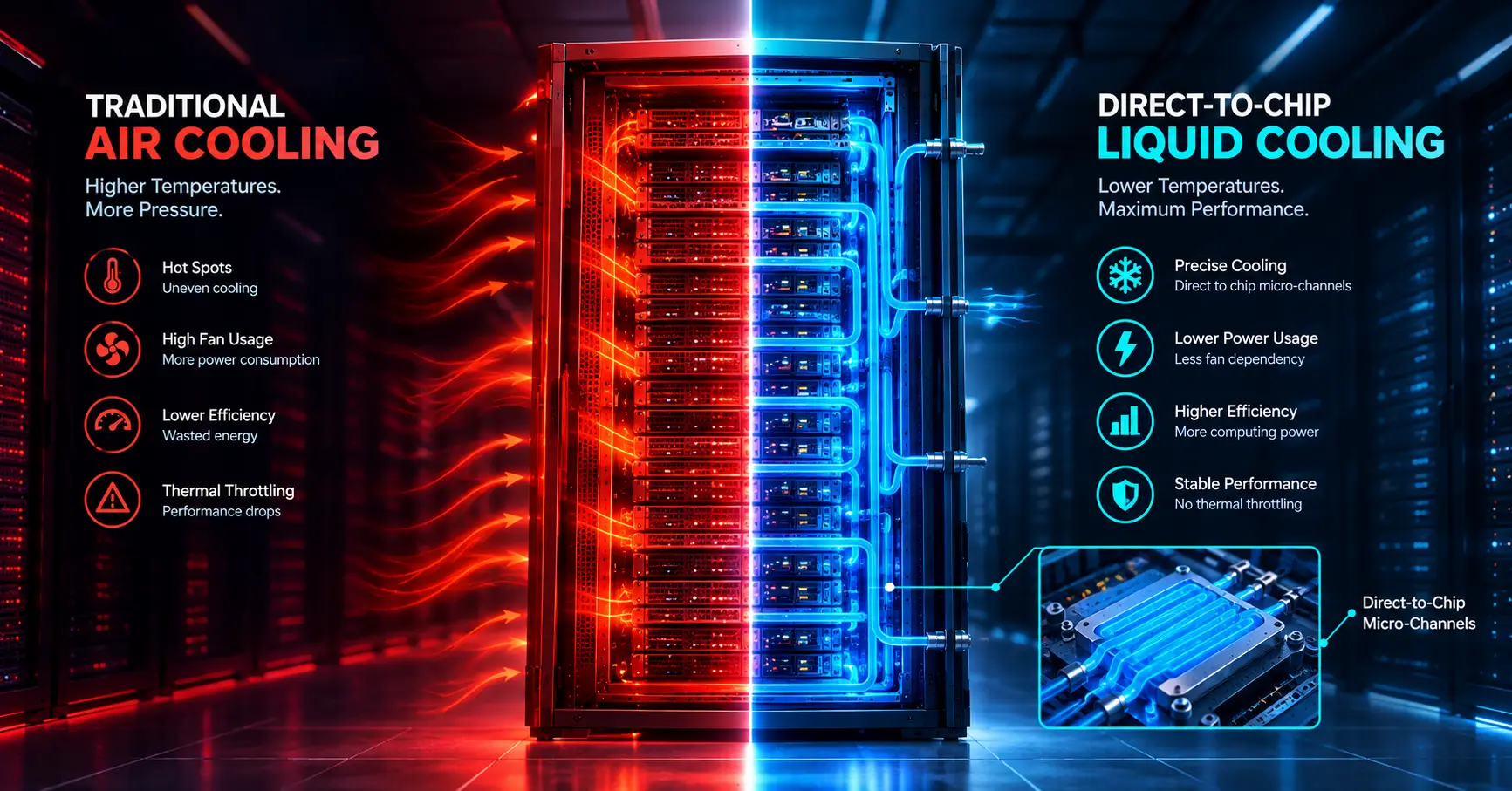
Modern bare-metal servers achieve high eco-efficiency through advanced direct-to-chip liquid cooling loops and localized heat exchangers. Water has a thermal carrying capacity roughly 3,500 times greater than air, allowing liquid cooling systems to remove heat directly from the processor substrate far more efficiently than standard air conditioning fans. This drastically reduces the energy required to cool the environment, bringing the infrastructure's Power Usage Effectiveness (PUE) down toward an optimized 1.2 baseline.
Furthermore, single-tenant physical platforms eliminate the energy overhead introduced by virtualization software layers. In a virtualized cloud environment, a noticeable percentage of physical CPU cycles is continuously consumed simply by running the hypervisor itself and managing multi-tenant resource boundaries. On an unshared bare-metal platform, that software overhead drops to zero. Every watt of electrical energy drawn by the system goes directly toward executing your specific code, processing database queries, or serving application traffic. This ensures maximum computational output per kilogram of carbon emitted.
Strategic Routing: Paris as the Sovereign High-Speed Core
While sustainability is an absolute priority for modern operations, it must be matched by exceptional network connectivity. Paris stands as one of the world's premier network routing capitals, functioning as the primary connectivity anchor for mainland Western Europe.
Deploying compute resources inside Paris dedicated environments positions your applications directly on the core fiber optic backbones of Europe. The city provides direct peering with major international internet exchanges, such as France IX, ensuring that data packets can transit seamlessly to surrounding economic hubs like London, Frankfurt, Brussels, Amsterdam, and Madrid with minimal intermediate network hops. This direct network configuration keeps point-to-point round-trip times (RTT) across Western Europe within single-digit milliseconds, delivering the instantaneous responsiveness required by modern financial applications, content streaming platforms, and enterprise API gateways.
To build a highly resilient, completely compliant network across France, enterprises frequently pair their primary Paris compute core with strategic regional edge installations:
Marseille: The ultimate subsea cable gateway on the Mediterranean coast, connecting continental European systems directly to international landing lines extending across the Middle East, Africa, and Asia.
Gravelines and Roubaix: Vital infrastructure points in northern France, providing exceptional, high-capacity backhaul routes directly into the United Kingdom and the Benelux economic corridor.
Strasbourg: Located on the eastern border, offering excellent geographic redundancy and secure off-site data replication paths immediately adjacent to central European markets.
By building an infrastructure layout that links a primary Paris installation with these specialized regional sites, businesses can ensure continuous availability and fast content delivery while remaining fully aligned with national data sovereignty and environmental guidelines.
Protecting Energy Baselines: Hardware-Accelerated DDoS Mitigation
In the modern cybersecurity landscape, maintaining high infrastructure availability requires constant defense against malicious activity. In 2026, distributed denial-of-service (DDoS) attacks have grown dramatically in both volume and sophistication, presenting a significant threat to business continuity. However, mass volumetric attacks introduce an additional complication that is rarely discussed: a massive, artificial inflation of your infrastructure's carbon footprint.
When a server is targeted by a major botnet flood, the operating system's network stack is forced to spend massive amounts of CPU cycles simply parsing, inspecting, and dropping millions of malicious data packets. This sudden, intense processing load causes processor power draw to spike instantly to maximum levels, driving up energy consumption and severely degrading your infrastructure's PUE efficiency metrics.
Defending against this operational threat requires enterprise-grade, hardware-accelerated scrubbing systems built directly into the core network edge. This architecture isolates your systems from malicious traffic long before it can reach your physical server interfaces:
(Pure, Filtered Traffic)
By filtering out junk data streams at the network carrier layer, advanced mitigation systems ensure that your dedicated hardware only encounters legitimate, authorized user requests. This automated, multi-layered defense protects your applications from unexpected downtime while insulating your systems from the sudden energy spikes caused by malicious attacks. This step preserves your carefully managed environmental metrics and ensures stable, predictable operations.
The iDatam Eco-Efficient Blueprint in Paris
Deploying an enterprise-grade footprint that satisfies the strict environmental demands of 2026 while delivering elite computational performance requires an experienced infrastructure partner. iDatam has specifically designed its footprint in France to provide organizations with a powerful, highly sustainable hosting environment that addresses both regulatory requirements and performance goals.
Advanced Green Physical Environments
iDatam’s Paris dedicated environments are located within premium, highly efficient data center facilities designed to meet modern environmental standards. These locations operate with optimized PUE profiles, utilizing low-emissions power configurations, closed-loop liquid cooling installations, and advanced waste heat recovery integrations that fully satisfy the transparency expectations of the DDADUE directive.
Enterprise Bare-Metal Component Standards
iDatam refuses to compromise on the quality of its physical hardware. Every server configuration is assembled using top-tier, modern components engineered for continuous enterprise performance:
High-core-count AMD EPYC and Intel Xeon Scalable processors that deliver exceptional computational throughput per watt of energy consumed.
Scalable DDR5 ECC (Error-Correcting Code) memory setups that actively detect and repair memory errors to prevent system instability.
Blazing-fast NVMe solid-state storage arrays configured in redundant hardware RAID setups, providing exceptional input/output speeds alongside data redundancy.
Full Sovereignty and Flexible Networking
When you deploy your workloads with iDatam, your engineering teams secure complete, root-level control and IPMI access from the BIOS layer up. There are no shared software management systems, no hypervisor abstractions, and no unmonitored cross-border data movements. Network lines can be tailored to meet your precise application requirements, featuring high-capacity uplinks and unmetered bandwidth options to handle massive data distribution without artificial cost penalties.
Building a Long-Term Foundation for Your Digital Growth
The modern European digital economy rewards organizations that recognize that performance, security, and sustainability are deeply connected. Attempting to manage resource-heavy enterprise platforms, sensitive databases, or real-time AI pipelines within legacy, inefficient cloud setups creates unnecessary latency penalties and serious regulatory vulnerabilities under modern disclosure laws.
Choosing single-tenant, energy-efficient physical environments in the French capital provides your business with a resilient, highly capable operational foundation. By combining raw processing power with immediate proximity to major global network exchanges, your applications can deliver the fluid, instantaneous experiences your users expect while remaining perfectly aligned with strict environmental guidelines.
Do not allow your business growth to be limited by cloud virtualization layers or complex international compliance frameworks. Explore iDatam’s complete line of France hosting services and discover how custom-tailored Paris dedicated environments can elevate your company's operational speed, digital security, and environmental compliance across the European Union today.
iDatam Recommended Resources

Hardware
Why Are Intel, AMD, and Ampere Dominating the CPU Market?
When we choose a CPU, we had a lot to consider. However, the landscape of CPUs is mainly dominated by a few key companies depending on the market segment. No matter what kind of CPUs you're looking for, here's a breakdown of how things evolved and where they stand today.


Hardware
What is ARM?
ARM (Advanced RISC Machines) is a widely used family of RISC architectures developed by Arm Ltd., known for its energy efficiency and scalability. Since its founding in 1990, over 180 billion ARM-based chips have been shipped, making it the leading processor family globally.

Hardware
A Complete Guide to RAID Configurations: Balancing Performance and Data Protection
This guide digs into the world of RAID configurations, examining their advantages, disadvantages, and ideal use cases, as businesses and individuals increasingly seek ways to optimize their storage solutions in a data-driven world.
Discover iDatam Dedicated Server Locations
iDatam servers are available around the world, providing diverse options for hosting websites. Each region offers unique advantages, making it easier to choose a location that best suits your specific hosting needs.